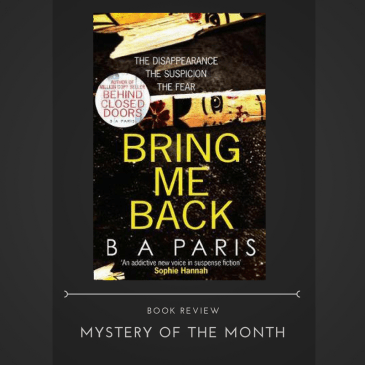
Mystery of the Month – Bring Me Back

Layla is the love of Finn’s life. But on a trip to France, Layla vanishes at a truck stop and is never seen again. Twelve years later, Finn is engaged to Layla’s sister, Ellen. One day, Finn arrives home to find Ellen holding a painted Russian doll, which she says she found on the pavement outside their Simonsbridge home. Finn soon begins receiving more dolls – in the mail and sitting on the stone wall outside their house. The only people who could know the significance of these dolls are Finn and Ellen. It appears Layla is back. And she’s not happy about Finn and Ellen’s engagement.

Bring Me Back is the third page-turning thriller from author B.A. Paris, whose debut domestic malice novel Behind Closed Doors was met with rave reviews and has recently been commissioned for a film. Her second novel, The Breakdown (probably my favourite) was a murder mystery filled with mind games of a ‘gaslight’ variety.

This time, the narrator is investment banker Finn, who straight up tells the reader he hasn’t told the police the whole truth about Layla’s disappearance. He also has a tendency towards violent rages, but has so far managed to control himself. Or has he? Finn becomes concerned his ex-girlfriend Ruby, who works down the road at the local pub, is pretending to be Layla because she’s jealous of his engagement to Ellen. But that doesn’t explain why someone saw Layla at the cottage she shared with Finn in Devon or why Ellen is convinced she saw Layla in Cheltenham.

Part one is told solely from Finn’s point of view, alternating between the past, where he describes his relationship with Layla, and the present. But part two switches between Finn’s point of view and a new surprise point of view character – Layla. But is this really Layla? And if it is, why won’t she reveal herself to Finn and Ellen? And where has she been for the past twelve years? One thing is for sure, Layla, or whoever she is, is testing Finn.

I thought I had the solution by the midway point of the story but clever writing and a raft of twists and turns had me second and third guessing myself. In the end, it doesn’t matter if my theory was right or not, because it’s this ability to keep the reader guessing that’s the mark of a good suspense writer. The solution to the story is slowly revealed like one of Layla’s Russian dolls – each layer removed until the last doll shows us where she’s been hiding.

Some reviewers have suggested the final reveal is somewhat unbelievable but I tend to disagree. The world we live in can be a pretty crazy place, and bizarre things happen every day – so why can’t readers stretch their imaginations and enjoy the possibility of something crazy happening in an entertaining crime fiction story? The final pages where we find out what really happened to Layla are gripping and devastating with tragic consequences.

Anyone who picks up a B.A. Paris novel is guaranteed a good read and Bring Me Back is definitely one to file under “I have to know what happens!”

Bring Me Back by B.A. Paris is published in Australia by Harper Collins.

Standout Simile

Through the rain, my eyes pick out the inky waters of a loch to my left, black reeds jutting through its surface like a three-day growth and I reduce my speed, searching for a cattle grid. Seconds later, my wheels find it, jarring my concentration. I pull in on the other side of the grid. As I get out of the car, adrenalin courses through me.
When Your Subplot Takes Over

Steve Urkel has taken over my story.

Well, not actually. Allow me to explain.

Family Matters was a sitcom about the trials and tribulations of the Winslow family. One day, a supporting character in the form of nerdy neighbour Steve Urkel made his first appearance. He kept showing up. Then suddenly, he became the main character of the show. He wasn’t even a member of the Winslow family. But now he’s arguably the most memorable thing about Family Matters.

This is an example of a story where a supporting character outshone the main character (presumably family patriarch Carl Winslow), eventually taking over the story and becoming the star. The original premise of the TV show was no more; it was all about Urkel. And now I’m concerned that the supporting narrative, or subplot, or B story, in my work in progress, is at risk of being ‘Steve Urkeled’.

In my murder mystery, The Princess Murders, the main plotline follows the main character, Sylvie, a private investigator trying to solve the murder of her best friend, Bianca. Running parallel is a subplot involving Sylvie’s other investigation into the dodgy dealings of a local school teacher, Leeder. Although seemingly unrelated, these two plotlines come together at the climax to reveal they’ve been linked all along. The solution to the B story (Leeder) mystery is linked to the solution to the A story mystery (Bianca’s murder).

But as I wrote the first draft, quite freely and trying not to overthink things, Leeder kept showing up. Okay, I thought. He can stay there for now and I’ll just edit him out in my rewrites. But as I’m now working through, scene by scene, I don’t know what to cut. Is it because A and B are so intrinsically linked that I can’t separate them, or is it that Leeder is just like pesky Steve Urkel, and won’t leave the story alone?

The B story has to be apparent enough so the reader understand what’s going on, but it should be balanced throughout the story so that it adds to the A story without overwhelming it. Jordan McCollum has written a seven-part blog series on subplots that is well worth checking out.

Leeder is a sneaky character so it’s not surprising that he keeps trying to sneak into my story. But the main narrative is Sylvie trying to solve the murder of her best friend. Even though the B story is important to the A story, I know I’ve got to pare it back and focus on what The Princess Murders is really about. So, I’ve developed a checklist to help me determine which scenes need to be cut/edited/rewritten.

  • Does this scene involving the B story affect the main character? Could it be achieved another way?
  • Does this scene raise the stakes and increase tension and suspense? (Remembering this is a mystery novel, after all).
  • Do I need to include this much information or can I trust the reader to draw the right conclusions?
  • Will the main character go on to do things in the main plot without this B story scene?

The best advice comes from K.M. Weiland at Helping Writers Become Authors, who states:

“There are no subplots, just plots. As such, your goal is to integrate your subplot ideas into your main plot so seamlessly they’re inextricable. Although you will probably need to create certain scenes that revolve entirely around subplot ideas, it’s best if you can weave them into your main plotline’s concerns as much as possible.”

With enough thought, time and effort, I should be able to successfully de-Urkelise my story and re-focus on the main plotline (and definitely avoid any scenes where Leeder pops up and asks “Did I do that?”)


Mystery of the Month – The Seven Deaths of Evelyn Hardcastle

This is a whodunit like no other. It has all my most favourite things. Murder mystery? Check. Set in a dilapidated mansion? Check. Long list of suspects? Check. Twists and turns galore? Check. A sprinkle of sci-fi? Check.

Aiden Bishop is the main character, although you won’t find that out until later in the book. When we first meet him, he’s occupying the body of Sebastian Bell who is wandering through a forest, believing himself to have witnessed the murder of a woman named Anna. He can’t remember who he is, or where he is, but a mysterious voice whispers in his ear, hands him a compass and tells him to travel east. Bell finds a rundown old mansion – Blackheath – filled with people gathering for the birthday party of Evelyn Hardcastle. But tonight, Evelyn will be murdered.

Each day for eight days, Aiden awakens in the body of a different party guest. A man wearing a plague doctor costume explains Aiden must solve Evelyn’s murder in order to escape Blackheath forever, and he must do so before his rivals beat him to the solution, and before his hosts are picked off one by one by a creepy footman. It’s like a Cluedo version of Jumanji – Aidan has been sucked into a game where he doesn’t know the rules and with real life consequences. He’s trying to piece together a jigsaw puzzle without having the picture on the front of the box, but he soon comes to the conclusion that whatever’s going on is linked to the death of Evelyn’s brother, Thomas Hardcastle, nineteen years earlier.

Stuart Turton is to be applauded for brilliantly pulling off such an intricate narrative, tying up all the loose ends and providing satisfying answers to all of the questions. The meticulous plotting and planning is truly admirable as Aiden switches back and forward between the hosts he inhabits each time one of them falls asleep (or is knocked out) and the story has more surprise reveals than any other book I can think of. But Seven Deaths is best read without too many spoilers so the reader can peel away the layers, page by page, without knowing what’s to come.

Seven Deaths is beautifully written, rich with vivid metaphors that bring the characters and the setting to life, including an early scene where a man verbally abuses a maid in a crowded drawing room and everyone is shocked into such silence that “even the piano bites its tongue”, but a “heroic clock” still “drums up its courage and ticks.” All of the hosts Aiden inhabits are distinct, well-rounded characters with specific strengths and weaknesses and even the more deplorable ones are given redeeming qualities. His relationship with “rival” Anna is the strongest of the story as it grows from uncertain beginnings into a solid bond of trust and kindness, and yet we still wonder whether she is his ally or his enemy.

I could wax lyrical about this book for hours, writing thousands of words about how much I enjoyed reading it. It’s spooky and sinister and it’ll give you a few chills, but it also reflects upon the futility of retribution, the notion of whether someone can transform themselves, and the importance of being kind and giving second chances, making for absorbing and spellbinding reading. It’s only March, but I think it will be difficult to find a book I love more than this for my ‘best of 2018’ list.

Stuart Turton is a travel journalist who spent three years writing The Seven Deaths of Evelyn Hardcastle, his debut novel. He also has one of the best author biographies. I’m very excited to read what he has in store next.

The Seven Deaths of Evelyn Hardcastle by Stuart Turton is published by Bloomsbury.

Standout Simile

He’s standing behind me, mostly obscured by trees and bushes. In the uncertain light of the brazier, the mask appears to float in the gloom like a soul trying to tug free of its body.

Reading Your Writing Aloud

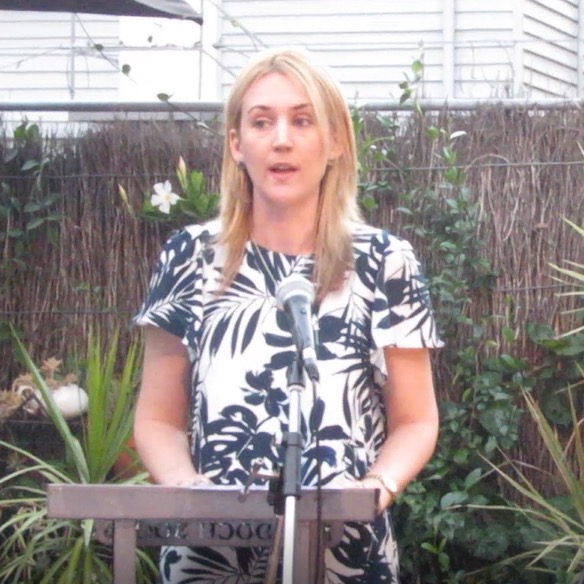
I was recently given the opportunity by the amazing author Kali Napier to read some of my writing at the launch of her novel The Secrets at Ocean’s Edge (now a bestseller) at Avid Reader in Brisbane. Kali chose to have an emerging writer’s salon to open her launch and asked me and Fiona Robertson, an award-winning short story writer to read some of our work.

What a mix of emotions! I felt grateful, honoured and thrilled to be given such an amazing opportunity, but also terrified. I’d never read any of my work in front of anyone before, let alone a group of 100 people. I’m petrified when someone reads anything I’ve written, let alone me reading it aloud at such an important event.

On the night, Fiona told me her daughter had given her some wise advice – no one would really be listening to us anyway. Fiona thought this was a good point – everyone would be waiting to hear Kali’s ‘in-conversation’ with Cass Moriarty. I agreed, hoping lots of people would trickle in late and miss seeing me at the start. (As it turns out, the audience did listen to Fiona and were very supportive and welcoming.)

Kali recommended choosing a scene with plenty of dialogue, less description and ending on a line of intrigue. (She also advised speaking slowly – not something I’m good at!) With this advice in mind, I chose a scene which occurs early in my mystery novel, The Princess Murders, where the main character, Sylvie, arrives at her friend, Bianca’s house. When Bianca doesn’t answer the door or her phone, Sylvie peers through a window and sees Bianca lying unresponsive on a bed. Another friend, Zara, shows up at the house and together they break into the house. Fiona had the audience captivated with a scene from her short story The Ground Beneath, about a woman who discovers a sinkhole in her backyard.

screenshot 2018-02-17 12.36.54
I survived my first experience of reading my writing aloud in front of an audience.


After choosing my scene, I made the outlandish decision to prepare for reading my work aloud by… reading my work aloud! Reading your work aloud is not a new concept and you’ll find lots of writers recommend this as a strategy to proofread your work. Lia Weston notes in her hilarious blog post that it is especially useful for dialogue and suggests taking things a step further by acting out scenes.

I read and recorded my scene on my iPhone using the Voice Memos app and played it back. After listening to it a few times, some awkward word choices and clunky pacing stood out to me. I even found an implausible action that I hadn’t noticed despite reading the scene on my computer screen multiple times. It wasn’t until I recorded it and listened back to it that I picked up this potentially embarrassing mistake. It also become apparent where I needed to add speaker attributions as it wasn’t clear who said what by simply saying “she said” with two females speaking in the scene.

The exercise of reading and recording my writing aloud helped me edit the scene down to a neat three-minutes reading time and in a way that was hopefully clear and concise with a nice balance between dialogue and description. I also tried different ways of emphasising certain words for dramatic effect but of course all of that flew out the window on the night when I stood in front of the audience!

As I continue rewriting/editing my manuscript, it will be useful to continue the practice of reading and recording my scenes aloud for other scenes, if not the whole book. (If I can get used to the weird sensation of listening to my own voice.)

Another great suggestion comes from Alisdair Daws, who states in his blog post Why You Should Read Your Writing Aloud, that writers who use Scrivener can use its text-to-speech feature. He provides instructions on how to do just that and this is definitely something I’m going to try (because then I don’t have to listen to my own voice!)

It was a great experience to read my work aloud and although I’m sure I will still be nervous if given the opportunity to do it again, at least I know I can survive the incredible dry mouth of anxiety and the sweaty palms of stress.

Click here to buy The Secrets at Ocean’s Edge by Kali Napier.

Click here to buy a copy of Fiona Robertson’s short story The Ground Beneath, published in Gargouille Issue 3.

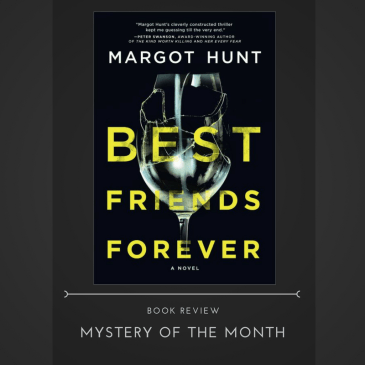
Mystery of the Month – Best Friends Forever

There’s a quote that says: “You don’t need a certain number of friends. All you need is a number of friends you can be certain of.” Alice and Kat are best friends, certain they can trust each other with absolutely anything. So why are there two police officers at Alice’s front door, asking her about the death of Kat’s husband, Howard?

Alice Campbell meets Kat Howard at the airport on a flight home to South Florida, where they bond over martinis and soon become firm friends. They’re an unlikely pair – Alice is an unassuming mother of two, writing a series of puzzle books for children, while art gallery owner Kat is a wealthy heiress with money to burn, used to getting what she wants.

Alice’s husband, Todd, becomes concerned about Kat’s influence over Alice and their marriage suffers a further blow when Todd loses his job. When Alice worries how she will pay overdue student fees, Kat is quick to write Alice a cheque for an enormous sum of money. This rouses the suspicion of the police investigating Howard’s death. Everyone thought Howard fell from the balcony of his two-story mansion in a drunken stupor but now a witness has come forward saying someone pushed Howard. There are lots of people with a motive to murder Howard – he was a disagreeable alcoholic who Kat insists was having an affair and who could also be violent.

The novel is narrated unreliably by Alice who jumps back and forward in time – between when she met Kat three years earlier and key moments in their friendship, to the present day investigation into Howard’s murder. Suspicions are raised when Alice begins to realise Kat hasn’t been honest about her relationship with Howard, her past friendships or her extracurricular activities. There’s a noticeable gap in the narrative – the events immediately leading up to Howard’s murder are missing – instead jumping to a few days later when Kat has inexplicably stopped responding to Alice’s calls and messages and Alice is questioned by the police.

Best Friends Forever has a cast of untrustworthy characters. Even Alice is hiding something from the reader – at face value she appears to be an ordinary woman who loves her family, but we know she is dishonest from the first few pages when she admits to hoping she is convincing when she speaks to the police. Kat’s motives are also unclear – she’s a deeply unhappy woman trying to conceal her true state of mind with alcohol and affairs with younger men, but we are uncertain how far she is willing to go to change her situation. These two women are intelligent, intriguing and crafty and their relationship makes for compelling reading, particularly the mystery as to how their incredibly close bond suddenly turns into a situation where Alice fears for her life.

No word is wasted and the book is heavy on dialogue, making it a quick and easy read – exactly what you want when you’re keen to find out what happens. Fans of B.A. Paris and Ruth Ware will enjoy this fast-paced thriller as the secrets both women have been keeping are finally unravelled in the last few pages. Margot Hunt cleverly drops hints, giving the reader all the information required to figure out what’s really going on, and just like the logic puzzles Alice enjoys, the reader will be weighing up evidence and trying to draw a plausible conclusion. Who is a knave and who, if anyone, will be the knight?

Margot Hunt is the pseudonym for American author Whitney Gaskell, a former lawyer who has previously written eight romantic and funny novels with female protagonists. This is her first psychological thriller, and her first novel under this name.

Best Friends Forever by Margot Hunt is published by Harlequin Books in Australia.

Standout Simile

It was also how she’d justify cutting me out of her life, like a surgeon slicing out a tumour.

The Roller-Coaster of Writing A Book

Last week I was feeling positive about my writing. But this week, I’ve been feeling quite negative.

I’m just over halfway through the first round of rewrites on my work in progress. After receiving feedback from a mentor, I’ve been strengthening character motivations, adding depth and texture and building on themes. Everything was progressing smoothly. But then I dipped into a sudden crisis of confidence. My mind was awash with irrational thoughts. You are wasting your life. The person who gave you feedback was just being nice. No one cares about your book.

This is the rollercoaster of writing a book (and could easily be applied to any creative pursuit). One second you’re cruising up the hill of productivity but then suddenly you’re charging down the steep decline of failure and going through the loop of self-doubt before coming to an abrupt halt at the procrastination station.

But rollercoasters are meant to be fun. They can be daunting, especially if you’re afraid of heights, but the thrill of flying through the air upside down and the excitement of your stomach dropping as you fall from a great height is worth that moment of trepidation before you get in and pull your lapbar down. So let’s try and flip this around.

The steep decline of failure

My goal was to finish rewrites by the end of January. Although there’s still over a week left before the end of the month, it’s not enough time to achieve my goal. I allowed procrastination to eat away precious minutes I could have been dedicating to my work in progress. I feel like I’ve failed.

But instead of screaming in terror, I remember the inspiration behind Bird by Bird by Anne Lamott – breaking down long projects into smaller parts. This makes goals more achievable and less intimidating. And instead of looking at my task as ten chapters left to review, I should be congratulating myself for already reviewing and rewriting 20 chapters!

As Roy Peter Clark says in Writing Tools: 55 Essential Strategies for Every Writer:  “Tiny drops of writing became puddles that become rivulets that become streams that become deep ponds.” I’m somewhere between rivulets and streams and by setting realistic and achievable goals, I’ll hopefully soon have a body of water like Lake Baikal (which, with a maximum depth of 5,387 feet, is the deepest lake in the world).

The loop of self-doubt

Almost every writer/blogger has a post about self-doubt. Because we’ve all been there. There’s even a great story about imposter syndrome from Neil Gaiman that went viral after author Alan Baxter turned it into a meme.

Dorothea Brande wrote Becoming a Writer in 1934 and said that every writer goes through the despair of wondering whether they have anything worth saying. What will readers think when they read my work? Or perhaps they’ve read the work of a genius writer and believe the difference between the work of the genius and their own writing is so large, they will never amount to anything. It’s reassuring to hear all writers suffer from self-criticism, but these negative thoughts can be debilitating. So what do we do when they have us in a twist?

Roy Peter Clark recommends making a list of the negative things you’re telling yourself – then burn the list and flush the ashes. Or Anne Lamott suggests isolating each negative voice, one by one, and imagining the person as a mouse. Then pick up the mouse by the tail and drop it into a mason jar, securing the lid tightly shut.

I have two choices. Keep going or give up. And if I’m going to keep going, then I have to expect that every now and then my confidence will throw a zero-gravity roll my way. And when that happens, I’ll do the mason jar thing.

Procrastination station

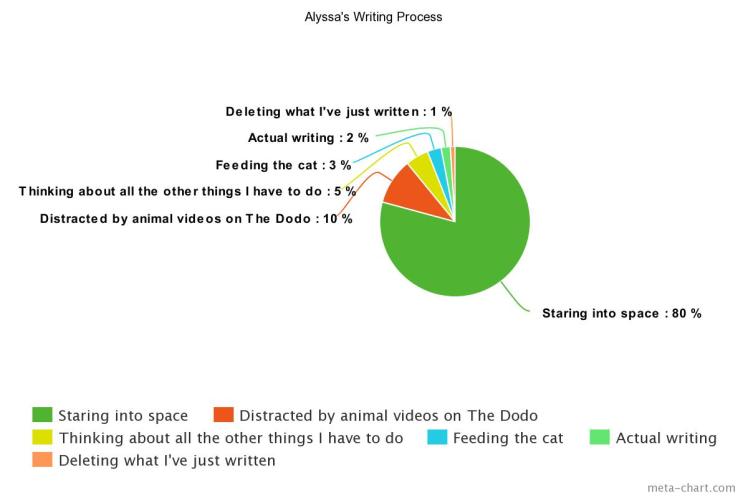
Then there’s all the time spent procrastinating – again, something most, if not all writers do. For example, my own writing process can be broken down by the following pie chart.

Pie chart of my writing process


Roy Peter Clark asks the following question about procrastination: “What would happen if we viewed this period of delay not as something destructive, but as something constructive, even necessary? What if we found a new name for procrastination? What if we called it rehearsal?”  For example, talking about writing with another writer is a great way to work through ideas. Or next time I’m staring into space, I can plan out ideas for my story my head.

Like a roller coaster, the process of writing a book has ups and downs. When you’re on the downward spiral of negative thinking, try these for positive g-forces – set achieveable goals, keep going, and eventually you will get the words down.

Buy Writing Tools by Roy Peter Clark.

Buy Becoming a Writer by Dorothea Brande.

Buy Bird by Bird by Anne Lamott.


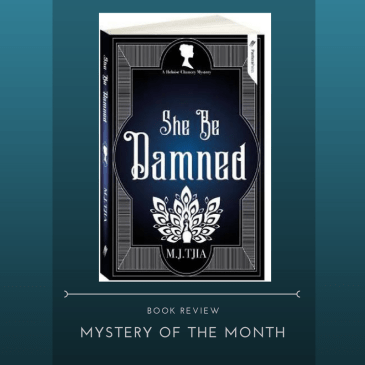
Mystery of the Month – She Be Damned

There’s a serial killer on the loose in Victorian London and the best woman is on the case – Heloise Chancey, courtesan turned private detective. She’s called upon by the kindly Sir Thomas Avery and his client, the large-eared and disagreeable Mr Priestly, to do a ‘spot of work’ – find missing seventeen year old Eleanor Carter, who has been thrown out of home for finding herself in an ‘unhappy condition’. They’re worried she may have fallen victim to a Jack-the-Ripper style killer who has already butchered four pregnant women, removing their sexual organs in what appears to be a botched hysterectomy, leaving the police perplexed.

Heloise has a history as a stage actress so Sir Thomas and Mr Priestly direct her to pose as a prostitute in the slums of Waterloo. But Heloise, who does investigation work for pleasure and not money, decides ‘I don’t need to be flat on my back or flashing my breasts to find this Eleanor girl’. She leaves behind her trusted maid, Amah Li Leen, and ventures to Waterloo where she intends to do things her own way.

M.J. Tjia is the pen name for Brisbane based author Mirandi Riwoe, who also writes literary fiction and whose novella The Fish Girl won the 2017 Seizure Viva La Novella Prize. She Be Damned, the first in the Heloise Chancey series, was long listed for the 2015 CWA Debut Dagger and has been picked up by Legend Press in London. Tjia depicts a gritty Victorian London for a gruesome murder mystery, evoking the era with a few well-chosen words from the dialect, vivid descriptions of the squalid living conditions, and shrewd observations of sexist and racist attitudes of the time. Women with unwanted pregnancies find themselves in a desperate situation with no support, no health care and limited options available to them, and the treatment of Amah Li Leen who, as a Eurasian woman, is viewed as dangerous and untrustworthy and forced to disguise herself in public or risk being openly abused in the streets.

Heloise is a dauntless main character who is well aware of the realities of life, having worked in the back alleys and brothels of Liverpool before earning her place as an esteemed courtesan living in Mayfair. With an ability to move between different social circles, she throws herself into the investigation using her instinct, intelligence and experience to question a range of unsavoury characters. There’s sneaky Madame Silvestre at the brothel where Heloise used to work, the dodgy back door doctor conducting ‘scrapings’, and Bill Chapman, an ambitious police sergeant investigating the murders in his own time in the hopes of getting a promotion.

She Be Damned moves along at a nimble pace starting with a violent prologue where the murderer claims his latest victim, and with a shocking turn of events halfway through the story. Li Leen’s backstory is revealed in mysterious interludes throughout the book, making her a sympathetic character and allowing the reader a different point of view of Heloise, leading to a significant reveal at the end.

These two brave, unapologetic leading ladies makes She Be Damned a historical crime fiction novel that is perfect for contemporary readers and a joy to read. There’s plenty of material for this to become a rich and engaging series of mystery novels and I eagerly await the next installment.

She Be Damned by M. J. Tjia is published in Australia by Pantera Press.

Standout Simile

I lie as flat as I can but my crinoline hoops pop up above my lower body like a shopfront awning.


5 Fave Crime Fiction Reads 2017

If 2017 wasn’t good for much, it was good for crime fiction. There were several stunning debuts, some decent follow-ups to bestsellers and a range of new releases from well-established authors. (Although no new Strike novel from Robert Galbraith yet). After much deliberation, I’ve chosen my five favourite crime fiction reads (stories with a crime/mystery theme) from this year. These are the page-turning, unputdownable best of the best – stories with strong characters, vivid settings and plenty of tense, thrilling moments.

1 – See What I Have Done by Sarah Schmidt

The Lizzie Borden case is the true story of a woman acquitted for the 1892 axe murders of her father and stepmother. Schmidt’s unique and visceral writing style perfectly captures the bizarre nature of this tale and of a family where there is no more love. Told from four distinct POV characters, Lizzie’s chapters feel so authentic I’m convinced that was exactly how she would have behaved. The closing paragraphs are some of my favourite writing from this year.

Standout Simile:  My spine hung like a beehive, a honey fizz pushing towards my head, and I felt ready to explode.

Buy See What I Have Done here.

2 – The Secrets She Keeps by Michael Robotham

Meg and Agatha are both pregnant and due around the same time. They’re not friends, but Agatha has an elaborate plan that will affect Meg’s life in ways she could never have imagined. The expression “I could not put this book down” has been used frivolously many times, but I legitimately could not put this book down. Robotham has told Agatha’s story so beautifully that I’ve never before felt so much sympathy for the villain of a story. A must-read.

Standout Simile: I adored everything about Jack – his smile, his laugh, his looks, the way he kissed. He was like an everlasting packet of chocolate biscuits. I knew that I’d eat too many and make myself sick, but I ate them anyway.

Buy The Secrets She Keeps here.

3 – The Word is Murder by Anthony Horowitz

The author is the main character in this fictional tale of a woman murdered on the day she was planning her own funeral. Her murder is being investigated by Hawthorne, a challenging character who hires Anthony to write a book about him. This clever literary device of author as narrator could only be pulled off by a masterful writer such as Anthony Horowitz and the result is completely engaging, using real life people such as Stephen Spielberg and Peter Jackson to great effect.

Standout Simile: I watched as he took out his wallet and produced a ten-pound note so limp and crumpled that but for the colour I would have been unsure of its denomination. He laid it on the table like an autumn leaf that’s been fished out of the gutter.

Buy The Word is Murder here.

4 – The Dark Lake by Sarah Bailey

My favourite thing about The Dark Lake is how much of a solid murder mystery it is. Gemma Woodstock is a detective in a small town investigating the murder of school teacher and old school mate, Rosalind. The investigation forces her to confront unpleasant truths from her own past. There are plenty of shady suspects, red herrings and legitimate clues to keep you guessing. A scene where Gemma faces a mother’s worst nightmare wins for my ‘most suspenseful scene of the year’.

Standout Simile: Blood surges, and it feels like tiny bugs are crawling through the capillaries in my eyelids.

Buy The Dark Lake here.

5 – Wimmera by Mark Brandi

Best mates Ben and Fab are schoolboys who both become victims of violent crimes. Brandi establishes a subtle feeling of foreboding from the first pages – we know something terrible is going to happen. At one point I wasn’t sure I’d be able to continue, unwilling to read what happens to Ben, but the brilliant storytelling had me hooked. Brandi tackles a dark and disturbing subject matter, exploring the plight of these powerless young boys with great care. It’s so well written, it’d be a crime not to read it.

Standout Simile: To the east of the curve was a flat, yellow patchwork of paddocks that disappeared in a shimmer below the stony face of the Grampians, looming like a tidal wave at the horizon.

Buy Wimmera here.

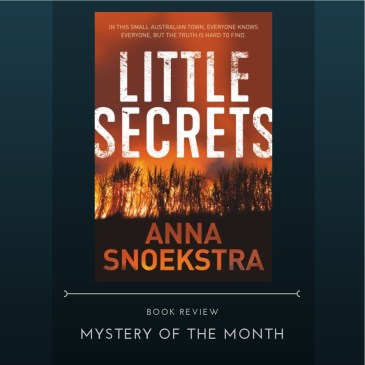
Mystery of the Month – Little Secrets

Rose Blakey is desperate to leave her hometown and fulfil her dream of becoming a journalist. So desperate that she’ll do almost anything. There’s nothing for her in Colmstock – her mother and her new husband want her to move out, and she’s fed up working at the tavern where she’s subjected to daily ogling from the local cop. She’s devastated when she misses out on the cadetship upon which she was hanging all her hopes. But when her little sister finds a strange porcelain doll on their doorstep that looks exactly like her, Rose realises she’s found the story that could be her ticket out of town.

Rose’s article about the mysterious ‘doll collector’ garners the interest of a local newspaper and stirs up fear amongst the community of Colmstock, who, thanks to Rose’s creative writing skills, believe a predator is targeting their children. But just when it seems like she’s finally gotten her big break, the newspaper rejects her follow-up story. Desperate to succeed now she’s so close to scoring her dream job, Rose pushes the boundaries, snooping in a hotel room for evidence, conducting stakeouts of dangerous drug deals and eventually fabricating a story in the absence of new information.

Anna Snoekstra is an Australian author whose debut novel, the hugely successful Only Daughter, has been published in more than 19 countries and last year was optioned for a screen adaptation by Universal Pictures. Little Secrets is different in mood and pace from her tense and disturbing first novel – but hints of darkness build a slow crescendo towards a horrific and violent act that is deeply unsettling.

The mystery surrounding the identity of the doll collector takes a back seat to a story about the impact a sensational news story has on a sheltered community – one that’s already wounded after a recent arson attack killed a young boy. What starts as one lie creates a ripple effect like a drop in the pond, as suspicions mount into a seething paranoia. Several mysteries are deftly weaved into the narrative – who burnt down the courthouse? What is mysterious out-of-towner Will really doing in Colmstock? And who are the creepy kids who disguise themselves by wearing paper plate masks?

Told from the points-of-view of Rose, her best friend Mia and policeman Frank, these layered, intricate characters each have yin and yang personalities, and like the paper plate kids, wear masks to disguise who they truly are. Is Mia really the wide-eyed, girl-next-door who cares for her ailing father? Is Frank just a faithful cop who deserves a chance with constant crush, Rose? And who will the residents of Colmstock side with when Rose uncovers brutal truths amidst all the secrets and lies?

There’s a lot going on in Little Secrets but thanks to Anna Snoekstra’s clever plotting, it never feels confusing or overwhelming. The depictions of life in Colmstock from Rose’s point of view describe a regional town in strife following the closing of the automotive factory and for her, a future that involves working at the poultry farm or the tavern, creating a sense of overwhelming claustrophobia. The narrative explores the devastating consequences of the written word in the wrong hands, how mercenary acts unwittingly affect innocent bystanders, and the dark side of human nature. Anna Snoekstra has created flawed characters with questionable morals who will leave you thinking about them long after the story reaches its bleak yet bittersweet ending.

Little Secrets by Anna Snoekstra is published in Australia by Harlequin Books.

Standout Simile

Since the fire, the Rileys had become almost famous in town, triggering silence and averted eyes wherever they went. Their grief followed the couple like a cape.

How Writing Short Stories Makes You A Better Writer

Writing short stories is a great way to hone your writing skills, especially if you are finding your way as a writer of longer-form fiction. As writer and blogger Katherine Crowley says, ‘when you write a short story, you go through the entire process of storytelling in a short time, from the inception to the editing – which is a great way to figure out your personal writing process.’

A few months ago I wrote a short story about a murder in Brisbane in the 1940s. It was loosely based on a real life event, but I fictionalised it, adding new characters and inventing a different scenario. By the time I’d finished, I was quite pleased with what I’d achieved and felt like it was a decent short story.

I submitted it to a few short story competitions, not really expecting to get anywhere, but naturally still hoping I might get longlisted for one of them. I was rejected by all of the competitions.

Fair enough, competition is pretty stiff. There are so many talented writers that trying to get your story to stand out can be quite challenging. But I wanted my story to stand out. And it wasn’t.

So I thought, instead of giving up (neverrrr!!!) or writing another, different short story (legitimate option) I would try and work out what it was about this particular short story that wasn’t inspiring the judges and try to improve it.

I enrolled in Short Story Essentials, a new course run by the Australian Writers’ Centre to learn more about how to structure a short story and what works and what doesn’t. The course was really helpful in showing me where I was on the right track and where I could consider making changes.

I’d already sought feedback on the story from a few beta readers, but either they were all too nice to tell me what wasn’t working, or they liked it enough but something just wasn’t grabbing them.

So based on what I learned in the short story course combined with my gut instinct, here are a few things I decided weren’t working in the story and how I changed them.

  • Too many different point-of-view characters. I had four. In a short story where you only have a limited amount of words, it’s confusing to be inside the heads of so many different characters. Now I have two point of view characters with one scene from the point of view of a detective.
  • Humdrum title. The first version was called A String of Pearls. Sounds a bit romantic for a murder mystery/thriller. New title – The Pearl Choker. Bam! That’s way better. Someone is obviously going to be murdered in a story called The Pearl Choker.
  • Predictable ending. It’s not essential for a short story to have a twist at the end but as I was writing a murder mystery/thriller, I wanted it to have a twist at the end. The reveal at the end of A String of Pearls was predictable. So I changed the killer. My beta readers have said they were surprised at the new ending. Yay! Success.
  • Trying to be too clever. In A String of Pearls, all of the scenes were out of order, marked with dates and times. This was because I wanted to start with a hook – the murder – which actually happens in the climax of the story (when told chronologically). This made things too complicated for the reader because they were flipping back and forth, trying to work out the actual order of events. The Pearl Choker is in chronological order and flows much better.

The amount of times I’ve rewritten the story is – a lot of times. I’ve lost count of all the different versions. But you know what? The rewriting has paid off because the story is better! And the beta readers who’ve read both versions agree.

So what now? I’ve submitted The Pearl Choker for feedback as part of the short story course. A professional editor will read it and offer more suggestions how it can be improved, which will be a great learning opportunity. After that, I might submit it to more short story competitions. I know there’s every chance it’ll be rejected by all of them, all over again. But rejection is part of being a writer.

Polishing my short story has shown me how much work is involved in rewriting and editing until a story is the best story it can be. I’m now daunted by the prospect of facing the same process with the first draft of my 95,000 word novel. Based on how long it took me to refine my 2,500 word short story, a rough calculation indicates that I’ll be working on my novel for the next 100 years. Or thereabouts. Phew! Maybe I should write another short story first …

Enrol in Short Story Essentials with the Australian Writers’ Centre here.