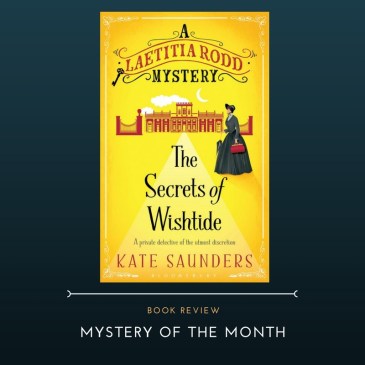
Mystery of the Month – The Secrets of Wishtide

The Secrets of Wishtide (A Laetitia Rodd Mystery) is a delightful cozy mystery from English author Kate Saunders. Kate writes for adults and children and her novel Five Children on the Western Front won the Costa Children’s Book of the Year Award in 2014.

In the Afterword to The Secrets of Wishtide, Saunders has said the novel was inspired by her fondness for Victorian fiction and in particular, the character of Little Em’ly from Charles Dickens’s David Copperfield.

SCANDALOUS SECRETS

‘Something absolutely tailor-made for you, old girl – it’s a job that requires nothing more than a little genteel probing and perhaps a modicum of eavesdropping.’ – Frederick Tyson.

It’s 19th century England and Laetitia ‘Letty’ Rodd is a respectable 52 year old widow living modestly in ‘Well Walk’ in Hampstead with her working class friend, Mary Bentley, following the death of her beloved husband, Matt, a clergyman.

To earn a few extra pounds, Mrs Rodd turns her hand to investigating matters brought to her attention by her brother, Frederick Tyson, a criminal law barrister, who describes Letty as a ‘veritable Sphinx’ when it comes to using her discretion.

Fred comes to Letty with the promise of earning big money from major ‘bigwig’ Sir James Calderstone who has received an anonymous note making scandalous allegations about a woman acquainted with his son, Charles. Charles is determined to marry penniless widow, Helen Orme, whom he met when Lord and Lady Calderstone employed her to teach their daughters Italian. Helen may be beautiful but the Calderstones are terrified her shady past will destroy their family’s reputation.

At the Calderstone estate ‘Wishtide’, Mrs Rodd works covertly as a governess to their two daughters to familiarise herself with its inhabitants and in doing so, uncovers more dirty little secrets than she anticipated, including some shocking information about Lady Calderstone’s past.

Letty visits Mrs Orme, finding her amiable and unwilling to marry Charles. But her finely tuned instincts are telling her something is amiss. Is Mrs Orme really who she purports to be?

A NOT SO CHARMING PRINCE

‘This is a man without a conscience, who commits murder without turning a hair…’ – Inspector Blackbeard.

When Wishtide’s unpleasant French maid and confidante of Lady Calderstone, Mlle Therese, is found brutally murdered, Letty finds a link to Mrs Orme’s past, namely a mysterious man named Savile. It’s not long before Savile also shows up dead and Letty suspects a serial killer is at large and desperate to cover his tracks.

Her suspicions are confirmed when Mrs Orme is also murdered in a violent and horrific manner and her companion left for dead. However, witnesses who heard Charles Calderstone arguing with Mrs Orme right before her death cause the fact-fanatical Inspector Blackbeard to arrest him for her murder. Letty knows Charles is innocent but can she find the evidence to clear his name before he is hanged?

What follows is a tale of blackmail, affairs, romance and illegitimate children as Letty tracks a cunning and sadistic character known only as ‘The Prince’, convinced that the unveiling of his identity will provide the solution to everything.

A COMFORTABLE COZY

‘Extreme old age does strange things to my memory. The past is fresh to me, vivid in every detail, felt in every sense. People who have been dead for years are suddenly filled with life again, and I hear their voices reminding me of things I had long buried. Whereas I couldn’t tell you what happened yesterday if you paid me.’ – Laetitia Rodd.

The Secrets of Wishtide follows the formula of a traditional cozy, placing violent murder in polite society where sips of scotch and a cup of tea immediately restore colour to the cheeks of those looking pale and peaked.

The story is told through the first person narration of Letty and in her letters to Fred and Mary. The effortlessly entertaining writing style of Saunders makes Wishtide a quick and easy read.

Although not so much a ‘whodunnit’ – we know the perpetrator is the mysterious ‘Prince’ and there are only a few people he could feasibly be – there is still plenty of intrigue to keep the reader turning the page, wondering what will happen next.

There’s also a hint of a burgeoning friendship of sorts between Letty and Inspector Blackbeard which readers can expect to develop further, as Wishtide is the first of six novels in the series.

The Secrets of Wishtide (A Laetitia Rodd Mystery) by Kate Saunders is published by Bloomsbury.


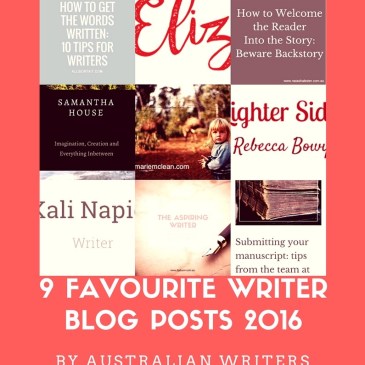
9 Favourite Writer Blog Posts 2016

This year, many impressive Australian writers, both published and unpublished, have been blogging about their writing experience and offering advice and support for others in the writing community.

Here is a list of my favourite blog posts from Australian writers this year – from tips on how to start your story, to staying motivated, through to the experience of having your manuscript assessed and getting published – there’s something for every writer, no matter what stage you’re at!

How to Welcome the Reader into the Story: Beware Backstory by Natasha Lester

Natasha’s post was particularly valuable to me because the first chapter of my manuscript was laden with backstory. Natasha uses examples from her novel A Kiss from Mr Fitzgerald to demonstrate how you can ‘drip feed’ the backstory into your novel.

Natasha’s next novel, Her Mother’s Secret is available for pre-order now.

How to get the words written: 10 tips for writers by Allison Tait

Allison’s informative blog has a special section for writers and one of her most popular posts from 2016 are these ten tips on how to make time to write, and how to make the most of the time you’ve made. My favourite is to stop editing and get the first draft down.

There’s also a link to her new online course, Make Time to Write.

Six Ways to Stay on Track with Your Story by Elizabeth Foster

Some great tips from Elizabeth, who is working on her second novel, on what to do when you find yourself getting a bit lost writing your story, such as keeping the ultimate goal at the back of your mind, studying what other writers do well and my favourite – imagining your work as a film or a play.

Elizabeth’s debut novel Esme’s Wish will be published by Odyssey Books in September 2017.

Networking: A Different Approach by Samantha House

Samantha’s blog is always open and honest and this thoughtful post is about asking for help as a writer if you have a shy, introverted personality. This is a common plight of many writers and Samantha addresses this by talking about connecting with other writers on social media, helping one another and building a supportive community.

My Top Ten NaNoWriMo Survival Tips by Marie McLean

Marie’s highly entertaining post is about how to cope during NaNoWriMo, however her hilarious survival tips apply to writers at any time of the year when they are trying to meet a deadline. It’s also an excellent example of how to write an informative and funny blog post.

The Aspiring Writer: Manuscript Assessment by Jodi Gibson

Jodi provides a wealth of fantastic advice in her ‘Aspiring Writer’ series and this post is one of my favourites. Jodi had her manuscript professionally assessed and she discusses step by step exactly what it means to have your manuscript assessed, the benefits of having one done and when to do it.

Submitting your manuscript: tips from the team at Hachette Australia by Sarah Fiddelaers

Sarah’s blog posts are always beautifully written and this one is no different. Sarah attended an event called ‘Inside the Publishing House’ at Hachette Australia headquarters in Sydney and has kindly shared everything she learnt from the publishers about how to give your submission the best chance of standing out.

From Writer to Author … by Kali Napier

I am looking forward to reading Kali’s debut novel, which will be published in February 2018 with Hachette Australia. In this post, she shares five lessons from her journey to becoming a published author, including always having another project in the pipeline, setting achievable goals, building your author platform, taking a leap of faith and keep writing.

These are just a few of the writer blogs I enjoy reading on a regular basis. I can’t wait to see what everyone gets up to in 2017. Happy Writing!


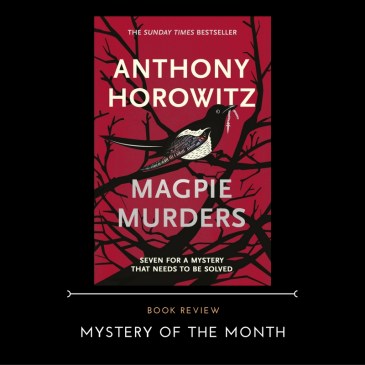
Mystery of the Month – Magpie Murders

Anthony Horowitz is the author of the popular Alex Rider series and has written for film and television, such as Foyle’s War, New Blood and Midsomer Murders.

In an interview with Sophie Masson, Horowitz describes his latest novel, Magpie Murders as “both a whodunnit and an exploration into whodunnits” and attributes the inspiration for the story to Conan Doyle’s mixed feelings about Sherlock Holmes. You can read the interview here.

This description encapsulates the idea at the centre of Magpie Murders – about an author who despises the main character of the series of novels that made him famous.

A MYSTERY WITHIN A MYSTERY

Magpie Murders cleverly places one murder mystery, a traditional cozy-style mystery set in a 1950s English village (also called Magpie Murders), inside of another murder mystery, set in the present day publishing industry.

Whodunnit the First – Present Day

‘I’ve watched every episode of Poirot and Midsomer Murders on TV. I never guess the ending and I can’t wait for the moment when the detective gathers all the suspects in the room and like a magician conjuring silk scarves out of the air makes the whole thing make sense.’ – Susan Ryeland.

Cloverleaf Books editor, Susan Ryeland is reading the manuscript for the ninth and final novel of the Atticus Pund detective series – Magpie Murders. It’s a book she says “changed her life forever”.

Hugely successful, the books are about to be turned into a BBC1 television series. But just as Susan reaches a crucial point in the story, she discovers the final chapters are missing from the manuscript. Not only that, but the unthinkable has happened.

A murder writer has been murdered.

Reviled author of the series, Alan Conway has fallen to his death from the tower of his home at Abbey Grange. Despite the discovery of a suicide note penned by Alan, Susan soon comes to believe he was pushed.

Lots of people had a motive to kill Alan – his recently dumped boyfriend, Jamie, who stands to inherit everything from his death; his disgruntled ex-wife; and the CEO of Cloverleaf Books Charles Clover.

Even Susan’s boyfriend Andreas refuses to reveal the real reason why he hates Alan so much.

Susan takes it upon herself to find out what really happened to Alan and she thinks the answer might be in those missing chapters.

Whodunnit the Second – 1955

‘One can think of the truth as an eine vertiefung – a sort of deep valley which may not be visible from a distance but which will come upon you quite suddenly. There are many ways to arrive there. A line of questioning that turns out to be irrelevant still has the power to bring you nearer to your goal. There are no wasted journeys in the detection of a crime.’ – Atticus Pund

Residents of Saxby-on-Avon are quick to place blame on Robert Blakiston when his busybody mother, Mary, housekeeper to Sir Magnus Pye, tumbles down the stairs to her death. They were seen arguing before she died.

Obsessed with clearing the name of her fiancé , Joy Sanderling goes to London to seek out the services of German detective, Atticus Pund. Sadly, Pund is nearing the end of a terminal illness and tells Joy he cannot help her.

But when Pund hears that Sir Magnus has been brutally murdered at Pye Ball, he journeys to Saxby-on-Avon to assist Inspector Chubb in solving the case.

Everyone is a suspect – the vicar and his wife are furious that Sir Magnus had plans to demolish the woodland behind their home; slippery Johnny Whitehead is the prime suspect of a recent break in at Pye Hall; creepy groundsman Brent is always lurking about; and, has Magnus’ twin sister Clarissa finally discovered the family secret?

Red herrings are cunningly placed throughout the narrative but there is one deadly secret that someone does not want revealed.

Then, just as Pund is about to reveal the identity of the killer, Susan realises the end of the manuscript is missing.

A HIDDEN MESSAGE

‘Not for the first time, I got the sense that he had been trying to tell me something, that he hadn’t just written the Atticus Pünd mysteries to entertain people. He had created them for a purpose that was slowly becoming clear.’ – Susan Ryeland.

Anagrams, acrostics and allusions are aplenty in Alan’s Magpie Murders and Susan must decipher the messages he placed in his work for clues as to who killed him. She soon learns Alan named his characters very deliberately, and that their descriptions echo people in ‘real life’.

Not only that, but Susan discovers Alan was a cunning character who enjoyed ‘borrowing’ ideas from others including copying Agatha Christie’s habit of using nursery rhymes in her novels by applying ‘One for Sorrow’ to Magpie Murders.

Agatha Christie’s grandson, Mathew Pritchard, also makes a cameo appearance in a scene where Susan interviews him after he witnesses Alan having a dispute in a restaurant – paying a nice homage to the mystery genre for which Christie is so revered.

Golden age detective fiction aficionados will appreciate the setting, characters and plot points of the 1950s mystery, but Horowitz adds another layer by offering a subtle critique of the detective genre – and he does so without going overboard into a metafictional diatribe.

Readers will be in suspense during the dramatic showdown between Susan and the killer, and the final reveal of Alan’s hidden message is a real hoot.

Anthony Horowitz has capably pulled off two complicated narratives without confusing readers. Both whodunnits are carefully plotted and leave no loose ends. Although it may not “change your life forever”, Magpie Murders is clever, entertaining and a must read for mystery fans.

Magpie Murders by Anthony Horowitz is published in Australia by Hachette.

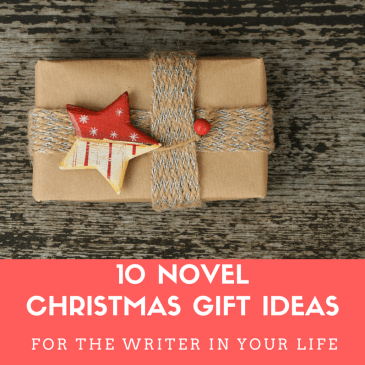
10 Novel Christmas Gift Ideas

Today makes it officially one month until Christmas Day.

If your loved one is a writer or avid reader and you haven’t started shopping for gifts yet, or if you’re a writer who’s wondering what to put on your wish list, look no further – here are some novel ideas!

1 – Novel Journal

A notebook and a novel in one, this nifty gift is a journal where you can write between the lines of your favourite book. That’s right, the lines you write on are actually the text of a famous novel! Choose between classics such as Pride and Prejudice, Emma, Dracula and Little Women.

Available from Bookface book stores or search for Novel Journal on Book Depository

2 – Pilot – A Diary for Writers

A must-have for any writer, the Pilot 2017 Diary for Writers is full of words of wisdom, handy reference pages, competition dates, writing inspiration and more. It’s all a writer needs to keep them organised for the coming year.

Available online: Pilot Press

3 – Gift voucher

With a wealth of courses to choose from, a voucher for the Australian Writers’ Centre will ensure you stay in the good books with your loved one well into the New Year. Ranging from $85 to $395, there are courses to suit every writer, including online courses for those who can’t attend in person.

Buy a gift voucher now: Australian Writers’ Centre

4 – Literary Tea

The Literary Tea Co are doing a special ‘Trio of Teas’ this Christmas. You can choose three of your favourite blends (for example: F. Scott Fitzgerald – Organic Early Grey, Blue Mallow, Cornflowers and Hibiscus; Charlotte Bronte – Organic Peppermint, Apple and Lemon Peel; Edgar Allan Poe – Organic Oolong, Skullcap and Mango) and have it gift-wrapped and posted for only $25! Perfect for lovers of classic novels and those who prefer tea over coffee.

Available on Etsy

5 – Bathtub Caddy

Give the writer in your life the gift of relaxation with a bathtub caddy. After a long day’s writing, they can relax in the bath, read their favourite book (without getting it wet) and there is even room for an all-important wine glass!

Available online from Hard to Find

6 – Book on One Page Print

Perfect to fill that blank wall space in a writer’s studio, these beautiful prints feature the words of an entire book as a picture. Choose from Peter Pan, The Wind in the Willows, Alice in Wonderland, Harry Potter and many more. A stunning conversation piece.

Available online from Hard to Find

7 – Grammar Grumble Mugs

Featuring clever phrases such as ‘The caffeine effect an affect us all’ and ‘Less milk and fewer sugar lumps’ these quirky mugs will be adored by grammar aficionados.

Get the full set of six online from The Literary Gift Company (which also has loads of other fantastic gifts available).

8 – Wonderbook – The Illustrated Guide to Creating Imaginative Fiction by Jeff VanderMeer

An aspiring author can never have too many books about writing and Wonderbook is the very first fully illustrated creative writing guide. It combines useful writing tips with beautiful diagrams and pictures and features contributions from George R.R. Martin, Neil Gaiman, Ursula K. Le Guin and many more.

Available online from Folio Books

9 – Domain Name

If the budding writer in your family hasn’t started building their author platform yet, give them the gift of encouragement by registering their domain name for them. If they’ve got holidays over the Christmas break, it could be the perfect opportunity for them to start developing their website. And with the added impetus of a brand new domain name, they’ll have no excuses!

Check out Net Registry, GoDaddy or Crazy Domains

10 – Livescribe 3 Smartpen

If you’re feeling particularly generous, the Livescribe 3 Smartpen will knock the socks off any writer who finds it wrapped up under the Christmas tree. The Livescribe does lots of snazzy things including digitising your handwritten notes and recording audio and it pairs with your tablet or smartphone for easy syncing.

Check it out at Officeworks

Mystery of the Month – Never Never

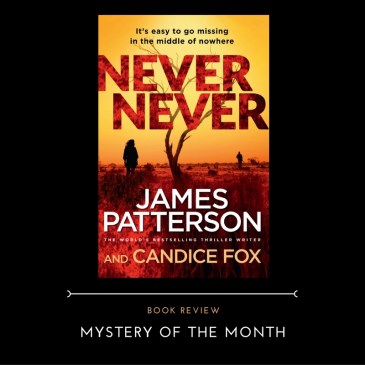
This month I devoured the thriller Never Never by James Patterson and Candice Fox.

James Patterson is a prolific, best-selling novelist who recently topped Forbes’s list of highest-paid authors for the third year in a row. Candice Fox has twice won a Ned Kelly Award, first for her debut novel Hades and another for its follow up, Eden, which took out best crime novel in 2015.

This dynamic duo is well equipped to write an edge-of-your-seat thriller and Never Never doesn’t disappoint.

A MERCILESS KILLER

‘Should this man die?’ – The Soldier

Who is The Soldier? That’s the mystery at the core of Never Never. We meet The Soldier on the first page, as he hunts a young man in the desert, pursuing him with his Barrett M82.

Obsessed with war, The Soldier plays deadly games with his prey – playing recordings of the screams of past victims while hunting new ones and blowing off body parts with expert precision.

He sees himself as a judge, with the power to decide who should live or die. For the most part, his verdict is that they should die, so he’s bumping off the poor unsuspecting employees of Bandya Mine, smack bang in the middle of the desert.

The desert is the perfect hunting ground. There’s nowhere to run in the never never. Especially not when your leg has been blown off.

The Soldier is a formidable foe.

Then he meets Detective Harriet (Harry) Blue.

A KICK ASS PROTAGONIST

‘Shock is unique to each individual. Some people go into hiccups. Some people’s teeth start to chatter. Some people collapse, go catatonic. The body can’t handle the total terror overload. The adrenaline dumped into the veins.’ – Detective Harriet Blue

A sex crimes detective based in Sydney, Harry’s chief (affectionately known as ‘Pops’) sends her to Western Australia in the wake of the announcement that her brother, Sam, is the Georges River Killer. Pops wants Harry clear of the media frenzy surrounding the case so he sends her to the uranium mine to investigate an “Unexplained Death”.

What Pops doesn’t tell Harry is that she’ll be partnered by Edward Whittacker (who Harry nicknames ‘Whitt’, much to his chagrin), a detective with swish suits and a penchant for pre-prepared meals. Harry is immediately suspicious that Whitt has been employed to spy on her in case she makes contact with her brother – a suspicion that only deepens when it appears he’s been fibbing about his past.

When Harry and Whitt arrive at the mine, they discover two more mine workers are missing. No one seems too worried – people leave the mine all the time without saying where they’re going. They usually turn up again. Just not dead.

There is a lot to like about Harry. She’s got a sharp tongue (i.e. calls someone a ‘dick hole’), has a mean right hook and has perfected the art of acting first and thinking later. But despite the tough exterior, there’s a soft side to Harry. She daydreams about her ‘fantasy parents’ (she and her brother were in and out of foster care as children), develops a fondness for a giant huntsman residing in the ‘donga’ (transportable building using as accommodation) she shares with Whitt and is patiently waiting for the right moment to cry.

By the end of the story, Harry is bruised and bloody, both physically and emotionally, but she will never (never) be broken.

A CHILLING CONCLUSION

‘There were scientific aspects to war, he thought. Strategic calculations. Risk versus reward. Probability, expectation, information management. You could measure war in its millions of variables, pitting optimal environment against available technology. Levels of training and quality of leadership. But it was the moral variations within war that interested The Soldier. How the battlefields could develop or destroy loyalty. It created heroes. It created traitors. The world needed war.’

There are more victims in Never Never than there are viable suspects, but there’s an eclectic bunch of characters to keep the reader guessing.

There’s a menacing drug dealer who trades a few punches with Harry; a militant security guard with a collection of disturbing magazines; a potential love interest for Harry who might want something more than just to star-gaze with her; and a mine supervisor who accuses her of concocting a story after she is viciously attacked by The Soldier.

There’s also intrigue surrounding another type of ‘soldier’ – a group of environmental activists, known as the Earth Soldiers. They’re camped out in the desert and have been causing trouble for the mine by staging demonstrations and chaining equipment together.

Although I guessed the perpetrator early on, there is a suspenseful scene towards the end that takes place high on a scaffold where a violent and unexpected act made me wonder what had just happened.

A whizz-bang novel, Never Never will hook you from the moment The Soldier’s first bullet whooshes past in the dark until the emotional cliffhanger ending. Thankfully, Candice Fox has promised there will be more Harry books.

“We’re greenlit, soldier. Move out!”

Never Never by James Patterson and Candice Fox is published by Penguin Books.


Is Your Mystery Novel Having An Identity Crisis?

I love mysteries. I love ‘whodunit’ mysteries where a murder takes place, there’s a cluster of possible suspects and the reader joins the protagonist in solving the puzzle that will uncover the face of the killer. Ideally, it’s set in an old country mansion where everyone has been invited to dinner and during the course of the evening, someone is bumped off. Unsurprisingly, ‘Clue’ is my favourite board game.

When you’re writing your own original mystery, you need to consider what type of mystery you’re writing. This is important when you pitch your novel to publishers, because they’ll want to know what to expect from your story. It may not be enough to simply state that your novel is a ‘mystery’. However, this can be difficult when there are so many different ways to describe a story that falls under the category of ‘mystery’.

Literary agent, Jessica Faust states in her blog post ‘Does Your Hook Match Your Genre?’ that there are three basic types of mystery – the cozy, the mystery and the suspense/thriller. The key words here are ‘basic types’. If we were going to be specific about all the different genres and subgenres of a mystery-based novel, which fall under an ever broader banner of ‘crime fiction’, I’d need to write a dissertation. And maybe I will. One day.

If the words ‘cozy mystery’ conjure up thoughts of snuggling into the couch on an overcast Sunday afternoon with a page-turner, you’d be on the right track. Despite the grisly subject matter of murder, a cozy mystery is usually light hearted. A cozy involves an amateur sleuth, often with a quaint hobby or occupation such as a librarian or florist, set in a small town and without graphic descriptions of violence or sex. An example of this is the Aurora Teagarden series by Charlaine Harris. Aurora is a librarian who lives in Lawrenceton, Georgia – a small town with a lot of murders, some of which are actually quite violent but are never explained in great detail. While there are police characters in the story, it’s Aurora who finds the missing piece of the puzzle that reveals the killer at the end.

The plain old ‘mystery’ may be better described as ‘modern P.I.’. The sleuth will usually have a connection to law enforcement, such as a medical practitioner or a private investigator. This type of mystery is darker than a cozy and may include descriptions of blood and gore. Robert Galbraith’s series of books about Cormoran Strike are among my favourite mystery novels. Strike is a war veteran and ex-SIB investigator who works as a private investigator in London and solves some really grisly murders involving disembowelment and severed body parts. In the most recent novel, Career of Evil, several chapters are told from the point of view of the unknown killer and getting an insight into his disturbed mindset is extremely unnerving.

A suspense/thriller involves a protagonist who is usually connected to law enforcement – often a police detective. Whereas in a mystery where we usually don’t know the killer until the end, in a suspense/thriller the killer may be revealed early (also known as an inverted detective story). This is often seen in television shows like Criminal Minds or Law and Order. In this type of story, the suspense comes from the protagonist’s mission to catch the killer, or stopping the evil, rather than solving the mystery. However, this isn’t always the case with a suspense/thriller. Joe Nesbo’s series about police officer, Harry Hole, fall into this category. In The Snowman, Harry Hole is on a mission to stop a serial killer and the story plays out like a ‘whodunit’ and the ending where the killer is revealed is reminiscent of Golden Age detective novels.

It’s great to know all these formulas for mystery/suspense and suspense/thriller novels but your story is your story and you need to tell it your way.

What’s your favourite type of mystery and why? Do you like to get involved in solving the puzzle or is it more about the suspense? Do you think I should write a dissertation? Let me know in the comments below.

Mystery of the Month – Closed Casket

Welcome to the first edition of my book review series, aptly titled “Mystery of the Month”. Apt because each month, I’ll read and review a mystery novel.

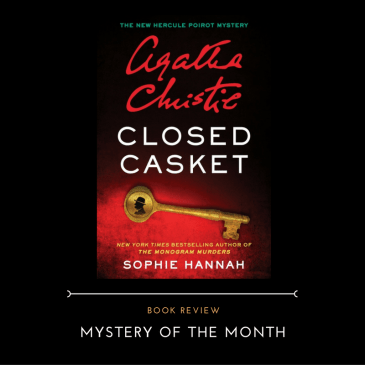
The first novel I’ll be reviewing for “Mystery of the Month” is Closed Casket by Sophie Hannah.


A PUZZLING PUZZLE

‘What is now clear to me, unfortunately it is also impossible.’ – Hercule Poirot

It’s October 1929 and esteemed detective Hercule Poirot is again paired with Scotland Yard detective Edward Catchpool (following Hannah’s first Poirot mystery, The Monogram Murders) when they are invited to ‘Lillieoak’ – the country estate of mystery writer Lady Athelinda Playford, in County Cork. They are not sure why they’ve been invited, but Poirot soon comes to suspect they are there to prevent a murder.

But whose murder?

Poirot thinks it could be Lady Playford after she announces at dinner there has been a change to her will in which she has disinherited her two children and inexplicably left everything to her terminally ill secretary, Joseph Scotcher.

Scotcher appears gracious and charming but he suffers from a kidney disease that means he has only weeks to live. Or minutes, as it so happens because later than evening, Scotcher is found brutally murdered in the parlour, his skull smashed into the oriental carpet. Quite a bit more gruesome than our usual Hercule Poirot fare.

Someone insists that she witnessed the crime and knows who the killer is. But can her recollection of events be trusted being that the person she named was seen moments later on the upstairs landing, wearing different clothes?

And how is it that Scotcher was heard begging for his life until the time he was bludgeoned, when the cause of death is later confirmed to be poisoning?


PLENTY OF SHADY SUSPECTS

‘People are peculiar little machines … considerably more peculiar than anything else in the world.’ – Lady Athelinda Playford

Closed Casket is teeming with loads of potential suspects. They all have fabulous names. Some of them have obvious motives to want Scotcher dead – but is that then too obvious?

I’ve mentioned the spirited and somewhat mischievous Lady Playford, who, if she could, would probably have left her estate to the fictional subject of her girl detective novels, Shrimp Seddon. (You could say Closed Casket is a mystery novel written by a mystery writer about a mystery writer who writes mysteries – it’s like Inception).

Then there’s Lady Playford’s newly disinherited daughter, the aloof and acerbic Claudia Playford whose wealthy fiancé, pathologist Randall Kimpton, seems to enjoy the sound of his own voice. Viscount Harry Playford is Claudia’s buffoonish brother, a taxidermist, and his wife is the neurotic Dorothy ‘Dorro’ Playford.

Scotcher’s endearing nurse and new fiancée, Sophie Bourlet and Lady Playford’s lawyer, Michael Gathercole, draw suspicion to themselves by going missing early in the piece.

Rounding out the list of suspects is Gathercole’s partner, Orville Rolfe, a browbeaten maid, a fractious cook and even a butler!

(I’m always very excited when there’s a possibility the butler might actually have done it).


A MYSTERY I COULD’VE SOLVED IF I’D JUST BEEN SMARTER

“When you know two things are true and those two things seem to go against each other, instead of telling yourself one must not be true, shouldn’t you ask yourself what third thing that you have not yet thought of would allow both true things to be true at the same time?” – Edward Catchpool

The traditional murder mystery formula is played to perfection in Closed Casket. The novel relies heavily on dialogue but it is written in an evocative and often humorous way. A favourite moment of mine was Poirot’s description of a monobrow as a moustache above the nose instead of below.

Although complicated, the mystery is solvable. Sophie Hannah has cleverly plotted out an intricate storyline that hinges on a “four word idea” that comes together like a ‘connect the dots’ puzzle by the time Poirot is ready for his grand denouement.

Early in the novel, there is a very obvious clue in plain sight that I didn’t notice. It’s mentioned at the end and I went back to check if it was there. It is.

The chapters all have titles, as Agatha Christie had done in some of her Poirot novels, and a few of these titles are subtle clues in themselves. There are also hints surrounding wordplay that might give some indication as to the murderer’s identity. Or you can just enjoy the story as it unfolds and leave it to Poirot and his little grey cells to explain one of the most inventive motives I’ve read in a long time.


Closed Casket by Sophie Hannah is published by HarperCollins.


Bring Out Your Dead

Excuse me for being bloodthirsty but when I’m reading a murder mystery, I’m expecting the murder to take place as soon as possible so that I can start solving the puzzle.

As mystery author of the Shinobi Mysteries, Susan Spann, states in her article ’25 Things You Need to Know about Writing Mysteries’, mystery readers will not wait a hundred pages for a corpse – they want death by page 50!

My personal preference is within the first three chapters. Otherwise, I find myself getting impatient.

If you’re writing a cozy murder mystery like me, the word count can be anywhere from 65,000 words to 90,000 words. If your mystery is at the shorter end of that range, it’s even more important to get that murder on the page as soon as possible – by making it the ‘inciting incident’ of your story.

This is the case in the first instalment of Joanne Fluke’s Hannah Swensen series Chocolate Chip Cookie Murder. We follow our amateur sleuth as she feeds her cheeky cat, brushes off her harassing mother, shows up for work at the bakery, discovers a dead body and makes me hungry for baked goods – all by the end of the first chapter.

The first novel in the Aurora Teagarden series by Charlaine Harris, Real Murders also features the murder early in the book. Within the first few pages, the reader is set up for something terrible to happen when Aurora arrives at a hall for a group meeting and receives a chilling phone call. As the other members of the group arrive, she begins exploring the venue and soon discovers a gruesome scene. So within a few short chapters, we know who our victim is and we have a group of potential suspects ready for cross-examination.

Esteemed cozy mystery novelist of three series, Elizabeth Spann Craig, notes in her article ’15 Tips for Writing A Murder Mystery’, that if there are too many chapters before the discovery of the body, they are likely there as backstory. We all know that too much backstory at the start of the novel can result in an extreme snorefest for the reader.

I made this mistake writing the first draft of my mystery. At least one third of my first 3,000 words were backstory, which bogged the story down, slowed the action and delayed the discovery of the murder victim. Once I cut the backstory out, the story had a better pace and now the murder occurs at the end of the third chapter. That backstory can be drip fed to the reader later in the story.

However, some mystery readers aren’t as concerned about the timing of the murder if they become absorbed by well written characters. In the first novel of the Her Royal Spyness Mysteries by Rhys Bowen, Georgie doesn’t discover a body in the bathtub until the middle of the book. The first half of the story is about Georgie – a member of the royal family who finds herself suddenly penniless – trying to make it on her own in London. Although I found Georgie’s escapades to be funny and entertaining and the character herself likeable and engaging, I couldn’t help but wonder when the murder was going to occur. This also left only the second half of the book to guess who the murderer was.

Fellow mystery readers, I’m curious to know – how patient are you when it comes to murders in mysteries? Do you like to know who the victim is upfront? Or are you just happy to go with the flow? Please sound off in the comments section below.

Belonging at the Brisbane Writers Festival

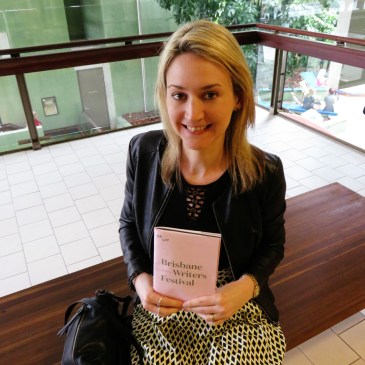
This was the first writer’s festival I have ever been to and I loved it. My interests in writing murder mysteries influenced the sessions I chose to attend.

The festival ran from 7 – 11 September at the State Library of Queensland with themes of connection, belonging and identity.

Here is a brief overview of the sessions I attended.

Being masterful with Caroline Kepnes

As soon as I saw that Caroline Kepnes was offering a master class on ‘Character’, my credit card took on a life of its own and my ticket was purchased without hesitation. Having recently read both You and Hidden Bodies, I jumped at the opportunity to learn from the mind of the writer who created loveable murderer, Joe Goldberg.

Then I freaked out a little bit. What even is a master class? I looked up a definition. Everything I read described a master class as being taught by an expert to ‘advanced’ and ‘highly talented’ students.

There’s no question that Caroline Kepnes is an expert in her field, but I didn’t consider myself to be masterful in any way! I might be masterful at sleeping in and eating an entire block of Cadbury Dairy Milk with Oreo Mint (maybe two). But writing amazing characters? Was I going to be way out of my depth?

My fears were assuaged when Caroline walked into the room on the day of the class. Her sunny smile, friendly disposition and natural sense of humour immediately made me feel at ease. She was not going to force me to stand up and read my work and then ask the rest of the class to point out the flaws. In fact, using an example from her own experience, Caroline’s advice was “don’t listen to praise, don’t listen to criticism” and to trust yourself.

Caroline was supremely knowledgeable about all things ‘Character’ and I was hooked on her every word (similar to how I felt reading her novels). Using Writing Fiction by Janet Burroway, she made the following key points:

  • Appearance isn’t just about physicality. Think about how a character appears to other characters when written from their point of view. For example, what does a student think/feel about their teacher when they see them outside of the classroom for the first time? What is their impression of the teacher in the ‘real world’ compared to the classroom?
  • Break down an action (e.g. if a character gives someone a Kleenex, when do they do it? Do they do it as soon as they start crying or do they watch them cry for a while first? Those decisions say a lot about a character. Maybe they derive some sort of sick pleasure from being around people who are sad).
  • Describe thought as an action. For example, in The Lovely Bones by Alice Sebold, action is described by Susie as she watches the earth from her heaven and observes souls as they travel, i.e. she “realizes things”).

As the session came to a close, Caroline Kepnes resolved to master the art of koala photos and I resolved to master the art of character. Stay tuned!

Historical fiction about women doing “shocking” things

In my festival booking frenzy, I also seized my ticket to see Natasha Lester discuss one of my favourite novels of the year A Kiss from Mr Fitzgerald in a Q&A session with Kathleen Jennings.

Natasha has been my tutor while I’ve been undertaking the course ‘Year of the Novel’ with the Australian Writers’ Centre. She has provided invaluable advice and inspiring words of wisdom to keep me and other students motivated as we write the first draft of our novels. I was thrilled to finally meet her in person. (And she signed my book! Squee!)

An avid reader of her blog (which everyone should check out if they haven’t already), I already knew a lot about her process writing A Kiss from Mr Fitzgerald. However, it was wonderful to hear her speak in person about the intense amount of research that she undertook in order to bring to life the tale of intelligent and determined Evelyn Lockhart who works as a Ziegfeld Folly in 1920s New York City in order to pay for her studies to become one of the first female obstetricians. A self-professed lover of archives, Natasha even consulted old fire maps of New York City to find out what buildings existed and where at the time the novel was set. That is dedication! And it certainly paid off because the descriptions of setting and place in the novel are flawless.

Upon reading the description of the Ziegfeld girls (measurements 36-28-38) in A Kiss from Mr Fitzgerald, I have to admit that I measured myself – curious to see if I would have stood a chance if I had auditioned alongside Evelyn Lockhart. Alas, not quite. I can’t sing or dance either but as Natasha noted, that didn’t matter so much to Ziegfeld as long as you looked the part. Today, if a woman wants to study medicine, there are study assist options available, more employment options available (including as a performer if she so desires) and expressing a desire to study anything, including medicine, is more likely to be encouraged by family rather than scorned.

However, despite this, Natasha also spoke about being approached by several women working in the medical profession today who told her that women are still experiencing bullying, similar to the type of bullying that Evelyn experiences from work colleagues in the novel. I discussed this with my friend afterwards and she wondered if this may be due to the fact that there are still older people in the medical profession who have retained that outmoded mindset. I can only hope that the explanation is that simple and that within a few years those people will retire and take their archaic views with them.

Natasha also spoke about visiting Paris to research her next novel (can that please be my life, too?) set in the 1920s/1930s at a time when the cosmetics industry was burgeoning and people were starving on the streets but were still horrified to see a woman wearing rouge. Scandalous! I cannot wait to read it.

It’s personal – crime that’s close to home

Senior Crown Prosecutor and author of true crime novel Kidnapped, Mark Tedeschi was quick to point out that the crowd who turned up to the “Crime and Curiosity’ panel was almost entirely female. He also noted that it’s usually males who commit crimes, but did the turnout at this session indicate that females are more interested in analysing those crimes?

I was very interested to listen to Mark, Kate Kyriacou (Senior Crime Reporter for The Courier Mail and author of true crime novel The Sting) and Emily Maguire (author of An Isolated Incident) talk about why society is so obsessed with pretty dead girls. Or in the case of these speakers, real examples of two dead little boys, namely Graeme Thorne, an eight year old boy kidnapped and held to ransom in 1960 and the subject of Kidnapped; and, Daniel Morcombe, who was murdered in 2003 by a paedophile whose capture almost a decade later forms the subject of The Sting.

A key point was how the authors used inspiration from their past, personal connections to write their stories. Mark spoke about being the same age as Graeme Thorne and keeping photographs of him so that he would recognize him if he saw him. Similarly, Emily lived in New South Wales in 1986 at the time when nurse, Anita Cobby, was abducted and murdered and that her sister caught the train from the same station in Blacktown.

Emily spoke passionately about victims and misconceptions about what make a woman “at risk”. In stories about murders that pique media interest, the victims often attract criticism, usually on social media. She shouldn’t have been walking down that dark alley. She shouldn’t have been wearing that outfit. Emily stated that based on the high levels of domestic violence homicides, women may be at risking by simply “living with a man”.

Emily’s empathy for the victim is at the forefront in An Isolated Incident. She told the audience that her intention was to not to write a traditional crime novel about forensics or the plight of the detective investigating the case. In fact, the novel contains no gratuitous descriptions of what actually happened to Bella Michaels, the victim in the novel. Instead, she wanted to focus on how Bella’s death affected those around her. I appreciated this as a point of difference to my own novel which is a cozy mystery and is much more about a detective solving the puzzle. However, after listening to Emily, I am inspired to think more carefully about the loss experienced by those who loved the victim.

Psycho or Socio?

Author Justine Larbalestier told the audience at the ‘Psycho’ panel that although people use the term sociopath more often these days, psychopath and sociopath are synonymous. However, I’m not sure Muse’s song Psycho which hisses the lyrics “psycho, psycho” would be as effective if Matt Bellamy sang “socio, socio”.

Nevertheless, the auditorium was packed to hear the vibrant and entertaining Meg Vann interview Caroline Overington, Caroline Kepnes and Justine (who, based on the fact that all three panellists have lived in the United States, noted that if her name was also Caroline, they would be the least diverse panel at the festival) about just that – the PSYCHO.

Justine is the author of My Sister Rosa, a story told from the perspective of the sibling of a ten year old “psycho”. She has thoroughly researched the disorder and responded to Meg’s question “what is a psycho?” by talking about epigenetics, how genes aren’t “fixed” and how environmental factors have an impact on the development of the brain. As she also states on her blog (which I recommend reading as she discusses complex things in a way that people like me can understand): “… the answer to nurture versus nature is BOTH. Psychopaths, like all humans, are a product of their genes, their environment and their brain morphology. None of those things are fixed”.

As Justine listed attributes of people with a psychopathic/sociopathic disorder, I mentally checked myself – lack of empathy and remorse (I cried in Marley and Me so I must be okay), being a thrill seeker (I’m terrified of rollercoasters so I must be okay) and charisma. Not the type of charisma that comes from a place of warmth and caring within a person but that strange kind of charisma that leaves you feeling drained and exhausted. Caroline Kepnes described these people as vampires who suck the life right out of you. Caroline Overington then told the audience that if we knew someone like that who wasn’t good for us, to just cut them dead. But not literally. (Because then you’d be a psycho).

A journalist for The Australian who has covered hundreds of murder cases, Caroline O also chilled the audience with her recollection of being in the court room for the trials of Gerard Baden-Clay and Brett Peter Cowan by stating that she knew she was in the presence of evil.

Caroline Kepnes then spoke of her experience being in the presence of a real life psycho by describing her gym teacher at high school, whom everyone always referred to as a psycho because of his behaviour. When the girls had their periods, he demanded proof by requesting to see their panties. Caroline K told the audience that, years later, this teacher was in Time when he attracted media attention for brutally murdering his wife and making up an unbelievable story to explain what had happened.

Talking about her fictional psycho, Joe Goldberg, Caroline K stated she invented a set of rules or a moral code for Joe to justify what he, as a character, thinks is acceptable. For example, Joe would never rape anyone. He’s not that kind of psycho. Instead, she describes him as a “veterinarian” who decides when people need to be “put down”.

To finish on a comment from Justine – everyone has a story about someone who is toxic. We should take Caroline Overington’s advice to “cut them dead” (figuratively).

Then we should put them in our books and cut them dead (literally).