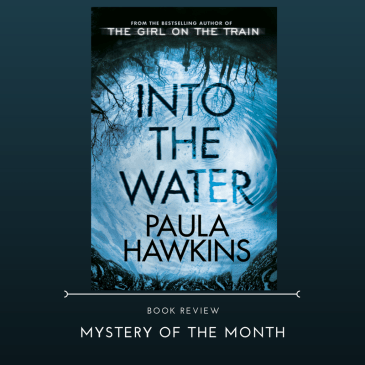
Mystery of the Month – Into the Water

An inauspicious river runs through the town of Beckford; women are drawn to its water and many have succumbed to its depths. Its latest victim is Nel Abbott, a single mother who was compiling a book about the Drowning Pool – ‘a place to get rid of troublesome women’. But it’s not the river that’s the villain of this story, it’s the residents of the small town through which it flows.

Paula Hawkins knows how to hook readers and her second novel, Into the Water, the follow-up to the international bestseller The Girl on the Train, has a compelling premise – a mystery about what really happened to these ‘troublesome women’ and an exploration of how memories can contradict the truth. Did Nel take her own life, like schoolgirl Katie Whittaker did earlier that year? Or was she pushed?

The town’s history is filled with gruesome fables of these women – from an accused witch bound by men and thrown into the pool in the 1600s, to a wife in the 1920s who drowned herself after slaughtering her husband. Then there are the rumours of a little boy who watched his mother jump from the cliff and into the Drowning Pool.

Into the Water has a lot of point-of-view characters. Nel’s estranged younger sister Jules Abbott returns to Beckford to care for Nel’s now orphaned daughter Lena. Jules’s narration is directed at Nel, whom she never forgave for a past wrong that occurred when they were teenagers. Lena is headstrong and proves to be a handful, and bursts onto the page demanding to know: ‘what the f**k do you think you’re doing?’

Then there’s Katie’s grieving mother, Louise Whittaker and little brother, Josh; Mark Henderson, a teacher who’s intent on escaping Beckford as soon as possible; resident psychic Nickie Sage, who is certain Nel didn’t kill herself; the Detective Inspector Sean Townsend, who’s investigating Nel’s death, his bland wife Helen, who has a peculiar relationship with Sean’s father, Patrick, a misogynist; and Detective Sergeant Erin Morgan who arrives from London and wonders why there isn’t a barrier on the cliff edge overlooking the Drowning Pool (but really – why isn’t there a barrier on the cliff edge?) Phew! With so many characters, it’s difficult to form connections with, or empathise with any of them, particularly Jules, who is a bit of a wet fish.

Into the Water is not the page-turner that The Girl on the Train was. It treads slowly and carefully through the storyline, quietly and pensively unravelling the lies, misunderstandings and misinterpretations beleaguering the residents of Beckford.

Hawkins has established an elaborate plot, cleverly interlocking the lives of her cast of characters together – all of whom have their part to play as each of their actions, even those that are seemingly small and of little consequence, have significant repercussions as the narrative heads towards its devastating conclusion. Although the clues required to solve the main puzzle are there from the very beginning, the final outcome is not obvious, but it is plausible. The ending feels like a sigh, a breath long held in and finally released in the very last sentence.

Inevitably, as The Girl on the Train became a Hollywood film, it’s likely this too will find its way to the screen, but would work best as a mini-series, similar to the suspicious small town portrayed in Broadchurch or the eerie and downright bizarre The Kettering Incident set in a Tasmanian coastal town.

Into the Water by Paula Hawkins is published by Doubleday.


7 Tips for Staying A Writer

I recently read a quote from Harlan Ellison:

Anyone can become a writer, the trick is staying a writer.

I thought this was interesting. How does a writer stay a writer?

It’s true, writing is a commitment. It’s easy to find an excuse to procrastinate and to do anything other than writing. But it’s also about having the right attitude towards your writing, having a passion for what you’re doing and not giving up when confronted with obstacles.

With that in mind, here are my 7 tips for staying a writer.

1. Develop a writing habit

Most, if not all writers, will tell you to ‘write every day’. Even if you only write for five minutes. Even if what you are writing is utter drivel. It’s about getting into the habit.

As Natalie Goldberg says in her book, Writing Down the Bones: Freeing the Writer Within:

My goal is to write every day. I say it is my ideal. I am careful not to pass judgement or create anxiety if I do not do it. No one lives up to his ideal.

We all have other commitments, whether it’s a job, volunteer work, household duties or family commitments. It can be very difficult to find time in your busy day to write. If you need more tips for how to develop a writing habit, check out a course run by the Australian Writers’ Centre – Make Time to Write.

2. Exercise your writing muscles

Claire Bradshaw states the main thing that makes your writing better is to do more of it.

If you wanted to run a marathon, you wouldn’t start out by running all 42 kilometres. You’d work up to it in shorter bursts. The same goes for writing.

William Kenower refers to the ‘writing muscle’ when he talks about writers who question ‘who has a talent for writing?’:

The short answer is everyone, just as everyone has muscles in their arms and legs. The longer answer is that not everyone’s been using their writing muscle — a powerful combination of curiosity and imagination — because they’re not entirely sure it exists.

You may not be sure it exists, or perhaps you’ve forgotten about it. A child is naturally curious and imaginative but as we grow older, we can forget this part of ourselves.

The best way to remember you have a writing muscle is to use it. You use it by simply writing. This might be by doing writing exercises, perhaps using writing prompts, or by keeping a journal. You can also exercise your writing muscle by giving yourself permission to write whatever comes into your head – even if it’s total crap.

And remember that like all muscles, your writing muscle needs rest, too. Give your writing muscle a break by using your other muscles – exercise by going for a walk, or a jog. One of the best things about your writing muscle is that often when you’re resting it, new inspiration strikes!

3. Forget about being perfect

I could argue that most writers give up on writing because they don’t think they’re good enough. This may not be true of all writers, but I’m sure it is for a large portion.

There’s a well-known quote about perfectionism in Bird by Bird: Some Instructions on Writing and Life by Anne Lamott:

Perfectionism is the voice of the oppressor, the enemy of the people. It will keep you cramped and insane your whole life, and it is the main obstacle between you and a shitty first draft. I think perfectionism is based on the obsessive belief that if you run carefully enough, hitting each stepping-stone just right, you won’t have to die. The truth is that you will die anyway and that a lot of people who aren’t even looking at their feet are going to do a whole lot better than you, and have a lot more fun while they’re doing it.

If you’ve been obsessing about writing your novel for years, it might be hard to accept that when you do sit down to write it, it’s not going to be perfect. But even your favourite writers don’t sit down and immediately churn out pages of beautiful prose.

Chances are you will read over what you’ve written and think it’s rubbish. Self-criticism and the futile pursuit of perfection can be your worst enemy.

Natasha Lester states:

Don’t let the inner voice of doom make you stop writing. Make it your most powerful motivator instead.

Perfect is boring, anyway.

4. Continuous learning

Max Florschutz states:

Accept this now: You will never reach the peak. The mountain top we’re striving for? It’s ever growing. There should never be a time when we look at a topic and think to ourselves “I know all there is to know on this topic, so I’m not going to think about it.” There is always something new to gain.

A writer can always learn more about the practice of writing, and this includes experienced, published writers.

A writer can learn more by: –

  • Reading
    • Read books across a wide variety of genres. Read for enjoyment and then read again with the eye of a writer. Pick out something you liked in the writing and ask yourself what it was that made you like it. Then pick out something you didn’t like and work out why you didn’t like it.
    • Read books on the craft of writing. Some of my favourites are Writing Down the Bones: Freeing the Writer Within by Natalie Goldberg, On Writing by Stephen King and How to Write Your Blockbuster by Fiona McIntosh.
  • Writing courses
    • From a one day workshop to a Masters degree, there are plenty of formal learning opportunities available for writers. Many courses are self-paced and available online, which makes things even easier. In Australia, online courses are available at the Australian Writers’ Centre, The Writers’ Studio and The Australian Writers’ Marketplace. Check out Writers’ Centres in your state or territory, or your local library for more information about courses.

5. Act like a writer

Firstly, you have to call yourself a writer. As Chuck Wendig says:

Here are the two states in which you may exist: person who writes, or person who does not. If you write: you are a writer. If you do not write: you are not. Aspiring is a meaningless null state that romanticizes Not Writing.

Don’t wait for someone to tell you that you’re a writer. No one else will believe it unless you do.

Noelle Sterne talks about how dressing like a writer, rather than wearing your tracky-dacks and sitting with ‘sleep-mouth and sandy eyes’ at your writing desk can make you feel different and more motivated to write. On the flip side of this, Candice Fox finds inspiration when she writes in bed. Find what works for you and stick to it.

Acting like a writer also means listening, observing and being alert. This may involve anything from eavesdropping on conversations to hear the way people speak to one another and paying a lot of attention to the minute details of your everyday life so you can call upon those details when you are writing.

6. Never give up

Finish what you started. Finish that first draft, short story, essay, or blog post, and don’t give up when it gets hard.

As Nat Russo says, a writer is passionate and it’s his passion that he calls on in times of trouble:

In short, you know if you’re passionate about writing or just curious. The curious open a word processor, hit an obstacle and say “guess I’m not a writer.” The passionate open a word processor, hit an obstacle and say “I’m a writer, dammit! I can solve this!”

A writer also needs to be prepared for rejection. Rejection and criticism are both inevitable at all stages of your writing career. Harry Potter was rejected by numerous publishers. And even as an established author, when JK Rowling wrote under the pseudonym Robert Galbraith, her first Cormoran Strike novel, The Cuckoo’s Calling was rejected by several publishers, including one who advised her to take a writing course.

The same goes for criticism. Bestselling authors still get bad reviews.

7. Have fun

Writing is work. You’ll spend hours, days, weeks, months and years working at it. But don’t forget it’s meant to be fun. If writing is your passion, there is no greater reward than creating believable, authentic characters, putting them into rich settings and telling their stories.

There’s a great quote from Now Novel about the joy of writing:

…keep in mind that writing can be a lifelong endeavour. It has no upper age limit, and you do not have to reach any particular milestone by the age of 30, 40 or even 50. Pace yourself, and you will have an activity that can bring you joy throughout every stage of your life.
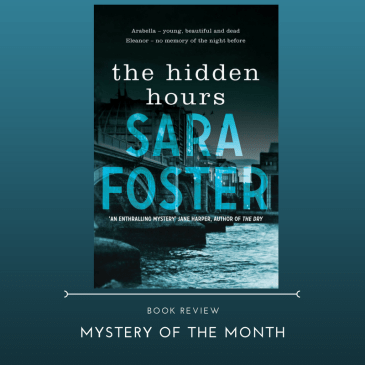
Mystery of the Month – The Hidden Hours

I’ve been searching for a book like The Hidden Hours by Sara Foster. It has all the elements of a cracking mystery – a dead body in the first chapter, a vulnerable protagonist you’re not sure if you can trust, a list of dubious murder suspects and my favourite possible setting for a murder mystery – London.

The Hidden Hours is the fifth psychological suspense novel from bestselling author Sara Foster. Her third novel Shallow Breath was long listed for the 2013 Davitt Award and having previously worked as an editor, Foster knows how to craft a compelling story.

Her world is beginning to unravel, pulling at the threads that bind the husk of her nine-year-old self, exposing the cruel edges of all that the years have failed to smother.”

Eleanor Brennan is a troubled woman in her early twenties with a habit of blocking traumatic events from her memory, including a horrifying scene from her childhood. Unfortunately for Eleanor, she’s just become embroiled in another shocking incident – the murder of glamorous marketing director, Arabella Lane.

Having recently moved to London from Australia, Eleanor hopes to start her life anew. She lives with her uncle, Ian and his wife, the formidable Susan, who gets her a job temping at Parker & Lane, the publishing company of which she is CEO. Eleanor is unsure of her aunt and uncle, aware of friction between the two, but develops a fondness for their daughters, Naeve and Savannah.

Desperate to fit in, Eleanor attends the Parker & Lane Christmas party. But the morning after, its employees are informed that Arabella Lane’s body has been dragged out of the Thames.

Eleanor knows she spoke to Arabella at the party. But she can’t be sure about anything that happened after Arabella slipped something into her drink.

“She squeezes her eyes shut and replays the evening again. She tries to fill in more of the night, but the harder she chases the memories, the faster they run until everything is dark and empty. The void is terrifying.”

As with all good fictional murder victims, Arabella was ‘livin’ la vida loca’. Drugs, affairs, strained relationships – lots of people had a reason for wanting Arabella dead. But could Eleanor be in some way responsible? And if she isn’t, then why does she have something of Arabella’s – something personal and important – in her handbag?

The narrative switches between two time lines – Eleanor’s childhood in Australia in 2004 and 2005, which begins just over a quarter of the way through the story, and the current timeline in London in 2016. As a child, Eleanor and her increasingly distant older brother, Aiden, are living in a shed with their parents while her enthusiastic and “relentlessly positive” father builds them a house from scratch on a perfect square of bushland.

Eleanor is haunted by these memories from her childhood, as a lonely and friendless young girl. The relationship between her father and mother is eroding, her absent brother gets mixed up with the wrong crowd and then there’s Solomon – the mysterious old widower living on the next property, who takes an interest in Eleanor’s sketching.

The reader really wants to know – what happened to Eleanor when she was a child? Who killed Arabella? But Sara Foster isn’t ready to tell us yet. Information is drip fed, chapter by chapter, dragging out the tension so the reader is filled with a sense of dread and unease, and compelled to keep turning those pages.

“Things are turning full circle, she can feel it: the ground is unsteady, as though the world is about to shift again. Something is coming. She needs to be vigilant. She needs to be ready.”

The Hidden Hours is really a story about Eleanor and the two major crises that happen in her life – one in the past and one in the present. Both timelines are written in present tense, highlighting how the events of Eleanor’s past still affect her in the present.

At times Eleanor is so vulnerable she almost becomes frustrating, but it’s hard not to feel sorry for her, particularly her awkward desperation at the Christmas party – everyone around her is talking and laughing while “she could feel herself slowly sinking away from them, invisible, despite every inch of her straining to fit in.” Every introvert who’s gone stag to a party will know how Eleanor feels in this moment.

Sara Foster builds a three dimensional world for the story by starting each chapter with short anecdotes from the point of view of other characters connected to Arabella – a doorman at the hotel where Arabella took her lovers, the chief pathologist, passers-by who saw Arabella the night she died, her drug dealer, and the paparazzi.

Eleanor’s relationships with those around her are believable, including a tentative flirtation with Parker & Lane art director Will Clayton, and with her cousins, particularly astute Naeve in whom Eleanor sees some of herself, drawing parallels between Naeve’s relationship with Ian and Eleanor’s tenuous relationship with her own father.

I’m always impressed when I’m wrong about the identity of the killer. Even as the story neared its conclusion and the list of suspects had dwindled, I was still surprised when Eleanor’s hidden hours were finally revealed.

The Hidden Hours by Sara Foster is published by Simon & Schuster.

Don’t mess up your novel by overthinking it

I am really thinking about words at the moment. This week I spent over two hours on a 100 word paragraph in my second first draft. Deliberating over which words to choose – ‘expanding’ or ‘stretching’? Which is better? I wanted to get it right. But if I keep this up, my novel will never be finished. For a 90,000 word novel, that’s about 2.5 months without sleeping.

Last year, I took an art class where the subject was drawing a tree. The tutor explained how to draw the tree in detail – how the roots curve into the ground, how the branches expand (stretch?) out, how to give the impression of leaves rather than draw each individual leaf. Then to add detail – where the light falls, maybe add a tree hollow or background features like a bird or a cute rock. She drew an example on the flip board and handed out instructions.

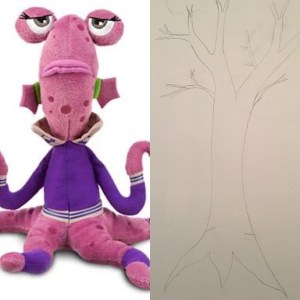
My first attempt at trying to copy the tree on the flip board was not good. It looked a bit like Carla Delgado – an octopus-like monster from Monsters University. My second attempt was only fractionally better and I still wasn’t feeling it. Frustrated, I thought: ‘I’ve just got to get this right!’

UHXQ5718
Similar


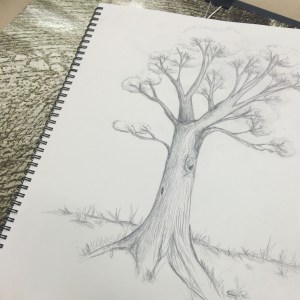
On my third attempt, I tried something different. I kept in mind the tutor’s instructions about how to draw the tree, but let the pencil flow without thinking too hard about what I was doing. This tree, Tree Number Three, turned out okay. I mean, they’re not about to hang it in the National Art Gallery but it looks like a tree and not a CGI octopus, which is a big deal.

170
Tree Number Three


Then I thought: ‘Is this a thing? Do I work better when I’m not thinking too hard about it?’ Turns out the answer is YES. And also, I’m a genius – because it is totally a thing. Based in SCIENCE.

The Scientific American wrote about a study where an associate professor at Stanford University Institute of Design and a behavioural scientist at Stanford’s School of Medicine designed an experiment based on Pictionary. Students were hooked up to a machine measuring brain activity and other technical science things, and given 30 seconds to draw a picture based on an action word. They indicated which word pictures they found more difficult to draw, while researchers decided which of their artistic efforts were the most creative. Turns out the participants’ left brains worked harder for the difficult word pictures and that they scored points for creativity when their right brain was more active.

Essentially, the less the participants thought about what they were drawing, the more creative their drawings were. Manish Saggar, a psychiatrist at Stanford and the study’s lead author, summarized the findings: “The more you think about it, the more you mess it up.”

I was messing up my tree because I was overthinking it. When I kept the tutor’s instructions about how to draw the tree in the back of my mind but didn’t overthink them, it actually became easier to draw. The same can apply to my writing. I know the process. The plot needs structure and turning points, and my settings need to be anchored, etc. – but when I write, I need to stop overthinking things and trust my right brain to pull the magic out of my subconscious.

This is summed up perfectly by K.M. Weiland on her blog, Helping Writers Become Authors:

Fiction is an amalgam of art and craft. We can think about craft. We should think about craft. Craft is an analytic, left-brain exercise. Art, on the hand, is a deeply subconscious, emotional journey. We shouldn’t think too hard about that—at least, not while we’re in the act. Thinking too hard dries up the creative side of the brain and dams up that subconscious flow of ideas, words, and images.

The left brain may still try to take over. Even when Tree Number Three was looking particularly tree-like, I used the eraser a few times when something wasn’t working, just like the way I might delete a sentence or paragraph.

And I was also compelled to keep adding to my illustration. What about a bit more shading here? Or another cute rock? The art tutor told me to stop – it was enough. So when you’re in your obsessive, creative right-brain state, you may add too many adjectives to describe the way your main character raises their eyebrows. It’s your first draft, and it’s not going to be perfect. But that’s okay.

As Robert Graham says in his book How to Write Fiction (And Think About It):

Each finished work will always in the end fall far short of the form you imagined it taking when you first conceived it. So it’s worth bearing in mind that there’s only so much you ought to do in the way of perfecting each piece of fiction you write; you might as well recognise that each new work you begin offers you a further opportunity to develop your craft, complete your masterpiece. There comes a point in the redrafting of everything you write when you will benefit from stopping and moving on to your next story or novel.

But redrafting is a blog post for another day, when we make friends with our left-brains again! Until then, I’ll keep my writing processes deeply rooted while I plant seeds of creativity and watch my novel grow as I think (but not overthink) about other terrible tree idioms.

Mystery of the Month – In Farleigh Field

In Farleigh Field: A Novel of World War II is a historical thriller from English author Rhys Bowen. Bowen is the writer of several bestselling mystery novels, including the award-winning Molly Murphy and Royal Spyness series. This is her first major stand-alone novel.

Set in World War II in the midst of the London blitz, the mystery our main characters must solve is exposing the spy hiding amongst them in their home at Elmsleigh in Kent.

Bowen, who was born towards the end of the war, had personal reasons for wanting to write about wartime and about the English people who would do whatever it took to win the battle of good versus evil.

STIFF UPPER LIP AT ALL TIMES

“We must set an example,” her father had said in his normal thundering manner, pounding on the table for better effect. “Never let anyone see you are upset or afraid. People look up to us, and we have an obligation to show them how it’s done.”

A soldier parachutes to his death in the fields of Farleigh Place, the distinguished Kent home of the Sutton family. He carries a mysterious photograph.

The Royal West Kent Regiment are occupying Farleigh Place alongside the Earl of Westerham, his wife, Lady Esme, and their daughters. The downed solider wears the Royal West Kents uniform but Colonel Pritchard declares he is not one of them.

Is he a German spy? And if the photograph is a message – who is the intended recipient?

Family friend of the Sutton’s, Ben Cresswell, is recruited to MI5 after an injury renders him unable to realise his dream of joining the RAF. He is tasked with finding out who the soldier was and who he was trying to communicate with.

Lady Pamela ‘Pamma’ Sutton, the Earl’s middle daughter, is working at Bletchley Park, decoding German messages. When she sees a newspaper article that her childhood sweetheart, flying ace Jeremy Prescott, has escaped the Stalag Luft and is back in England after being feared dead, she returns home to Farleigh, hoping to rekindle their romance.

But the suave and dashing Jeremy turns his nose up at the idea of marriage with Pamela – he just wants to get her into bed. As Pamela’s Bletchley cohort, Trixie, tells her – Jeremy is NSIT (‘Not Safe in Taxis’). This gives ‘steady as a rock’ and Pamela’s lifelong admirer, Ben, the opportunity to show her how much he cares for her as they work together to uncover the identity of the spy.

AN EXPLOSIVE REVEAL

She had not realised before that fear had a smell. She had always been told that dogs can smell fear but she’d never heard it said of humans. Yet she identified it now, sweet and palpable as she sat on the chair in a dark room. She was not sure whether the fear was coming from her own pores or was part of the building, oozing from the walls where so many people had felt terror and desperation.

Unbeknownst to her family, older sister Margot Sutton – who has been living in Paris and studying fashion under Coco Chanel inspired character, Gigi Armande – is in serious danger. She’s been taken by The Gestapo – they want to use her as bait to get information out of her lover, Gaston, a member of The Resistance, and they’ll use whatever force is necessary.

When Ben learns of a group called ‘The Ring’ (based on real life pro-Fascist movement ‘The Link’) – British aristocrats who want the war to end before Britain is destroyed, even if that means Germany wins – he begins to wonder if the spy is someone he knows.

While society’s elite enjoy a party in Jeremy’s Mayfair flat, another bomb attack takes place over London and the reckless guests gather on the roof to watch the show. At the same time, Pamela’s romantic aspirations are bombed by someone close to her.It all cumulates at Lord and Lady Sutton’s garden party where Ben and Pamela must prevent the assassination of the Prime Minister and the entire cast of characters assemble for a dramatic, gun-slinging showdown where the spy is finally revealed.

CARELESS TALK COSTS LIVES

Pamela sat staring out of the window, fighting back the nagging worry that threatened to engulf her. Someone should have broken the U-boat code for that day. Someone should have been able to warn the convoy and send out planes to protect it. Until now, her work at Bletchley had seemed like an academic puzzle unrelated to real events. But at this moment, the importance of what was being done in the huts there hit her with full force.

In Farleigh Field calls attention to the fact that many people were doing important work for their country during the war, unable to admit their true occupations to their families. The character of Pamela signs the Official Secrets Act and the Sutton family think she is undertaking tedious office work, like filing. And men like Ben may have been wrongly viewed as feeble because they weren’t on the front line, fighting with their fellow countrymen.

There’s lots of characters to love, particularly Alfie, the gamekeeper’s boy who develops a friendship with the youngest Sutton daughter, Phoebe. After their discovery of the fallen solider, the pair snoop around trying to find the spy and getting into strife. There’s also friction involving sister, Diana ‘Dido’ Sutton, who has been denied her season because of the war and parades around Farleigh looking like a fashionable land girl, batting her eyelashes at all the eligible men.

Plenty of suspenseful action scenes keep the reader engaged throughout and the subplot of the love triangle between Pamela, Ben and Jeremy plays out as expected but never ventures into cheesy territory. And although you may think you’re clever enough to correctly guess the identity of the spy, there’s a further twist you may not see coming.

Bowen deftly crafts the story with rich settings, impeccable historical accuracy and authentic characters in such a way that it feels like In Farleigh Field is a film playing inside your head. And with limited published autobiographies on the subject, Bowen allows those people who were sworn to secrecy for so long to finally have their stories told in compelling fiction.

In Farleigh Field by Rhys Bowen is published by Lake Union.

Stuck on the Middle

Think back to a time before you started writing. Those heady days when you blissfully read novel after novel, happily ignorant to the fact that somewhere in the story, there was a plot point known as a midpoint reversal.

You probably even read the midpoint thinking, ‘wow, what a twist!’ Or perhaps, ‘gosh, what is (insert main character’s name here) going to do now?’ Maybe you had a sense that a major shift had occurred in the narrative, propelling you into the second half of the story. But you didn’t question what it was. You just kept on reading, absorbing the story without analysing it.

That was how I used to be.

But now I’m hyperaware of PLOT (ugh, plot, amiright?) And within all those turning points that make up the plot, there is one particular turning point that you will usually find, oddly enough, in the middle of the narrative. You guessed it – it’s the midpoint reversal.

So now when I listen to a novel on Audible I think – I’m about halfway through. Surely something extra dramatic is about to happen soon. Or when I see my Kindle is at 50% but nothing earth-shattering has happened in a while, I wonder – where is the midpoint scene? Is it running late?

I recently attended a Plotting Masterclass run by author Natasha Lester where she discussed the emotional elements of plotting a novel. If you have the opportunity to attend one of Natasha’s masterclasses, I highly recommend it so that you can listen to her discuss in detail what she calls her ‘three story sparklers’ and the impact they have on plotting. But today, I’m focusing on that murky midpoint, which Natasha says is a big dramatic scene, often involving blood, death or break up.

Natasha has the following to say about the midpoint reversal:

  • It’s a key standout scene in your narrative
  • It’s caused by all the events that have led up to it and in turn causes all the events that follow it
  • It causes your character to stop reacting and to take action
  • It alters your character’s journey – they really start to fight for something, it teaches them a big lesson and causes them to change
  • When planning your midpoint reversal, you should ask yourself what is the event, what action does your protagonist take as a result and how does it change them?

In The Weekend Novelist Writes a Mystery, Robert J.Ray and Jack Remick say: ‘Midpoint is big. Spending time here now will make your writing easier later.’

In summary, the midpoint is super important, okay? Don’t stuff it up. No pressure.

Let’s take a look at some examples of midpoint scenes in books written by authors who totally knew what they were doing.

In The Girl on the Train by Paula Hawkins, Rachel sees a news report – they’ve found Megan’s body in the woods, less than five miles from her home. This is right near where Rachel was that night, only she can’t remember what happened because she was intoxicated. Staying true to the rule of a big, dramatic event involving blood, death or break up, this midpoint has a significant death. Rachel now decides to takes action. She feels guilty and responsible, and wonders if she could somehow have been involved in Megan’s death. She shows up at Megan’s house and forms a relationship with her husband. She actively spends the second half of the novel trying to remember what she did that night and trying to figure out what happened to Megan.

In Fetish by Tara Moss, the first novel in the Makedde Vanderwall series, Mak succumbs to the charms of Detective Andy Flynn while the killer sits outside her apartment, waiting for an opportunity to pounce. The next morning, Andy is awoken by a phone call telling him that soapie star Becky Ross has been found murdered by the ‘Stiletto Murderer’ – grossly disfigured and naked except for one stiletto shoe. This victim is in a much worse state than the others, indicating the killer kept her alive while torturing her. Andy realises with horror that the killer is evolving. Again, we have blood and death and the hunt for the serial killer intensifies with increased stakes for main character, Mak, as she tries to find out who murdered her best friend before she becomes the next victim.

In And Then There Were None by Agatha Christie, the midpoint reversal occurs after three murders have already taken place and the seven people remaining on the island realise that the killer is amongst them. They notice that each time one of them is murdered, one of the ten figures on the dining room table is removed. This affects the behaviour of all the characters as they grow paranoid, suspecting each other and fearing they might be next. They lock their bedroom doors at night and stay in groups as they move around the hotel.

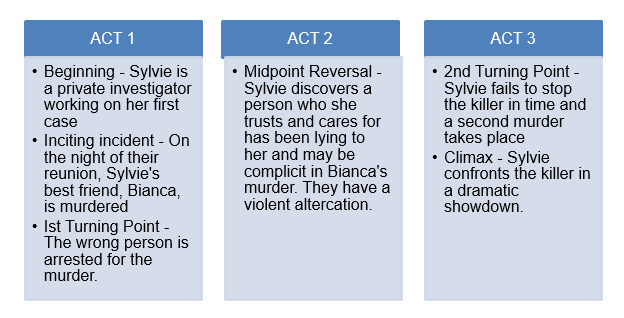
With all of this information in mind, I’ve crafted a midpoint reversal for my own story, The Princess Murders, which I’m hoping ticks all the boxes. In my story, Sylvie is investigating the murder of her childhood friend, Bianca. The diagram below shows the key plot points (summarised so they don’t give too much away – my husband is going to read it and I don’t want to give him too many clues.) The midpoint reversal occurs when Sylvie learns that someone she trusts has been lying to her and might be dangerous. Not only that, but a secret is revealed indicating that person may also be complicit in Bianca’s murder. In the scene where Sylvie confronts that person, a violent altercation ensues.

Screenshot 2017-03-20 18.50.27

Reflecting on Natasha’s words that the midpoint often involves blood, death or break up, I’m hoping I’ve got this covered because my midpoint has a little bit of blood and a definite break up – the relationship between Sylvie and the person who has been lying to her has been done irreparable damage.

As I continue to work on my manuscript, I’m also listening to Truly Madly Guilty by Liane Moriarty on Audible and I am not, under any circumstances, going to let myself become distracted waiting to analyse the midpoint scene. (But it’s going to be what happens at the barbecue – am I right?)


Mystery of the Month – The Girl Before

The Girl Before by J. P. Delaney is the latest in a line of thriller ‘Girl’ novels being hyped as the next The Girl on the Train or Gone Girl.

Delaney is the pseudonym of an author who has ‘previously written bestselling fiction under other names.’ If you do a Google search, it will tell you that J.P. Delaney is suspense and thriller writer Tony Strong, who has also written under other pseudonyms and whose works include The Poison Tree, The Death Pit, The Decoy and Tell Me Lies.

The Girl Before focuses on two women who take turns narrating the story – ‘Then: Emma’ and ‘Now: Jane.’

THE GIRL NOW

‘I know it must look odd, given that I didn’t even know Emma. But it seems to me that almost no one really knew her. Everyone I speak to has a different version of what she was like.’ – Jane Cavendish

Jane Cavendish is a single woman looking for an affordable rental home. She can no longer bear to live in the house where she was meant to bring home Isabel, the baby girl she lost following a tragic stillbirth.

A real estate agent suggests Jane look at One Folgate Street – a one bedroom house in Hendon, North London – designed and owned by famous architect and ‘wayward genius’ Edward Monkford.

Jane loves One Folgate Street’s minimalist-style, amazing architecture and state-of-the-art technological features. She’s keen to move in, but there’s a catch. Renting the house is subject to her implicit agreement to specific and stringent rules – no wastepaper baskets, no coasters, no cushions, or knickknacks. Jane must also complete a comprehensive application form asking intrusive questions about her past relationships, and a requirement for three recent photographs. Sounds legit, yeah?

Edward is pleased with Jane’s application and invites her to meet with him. Jane finds Edward dashingly handsome and naturally, her first thought is that she wants to sleep with him. Jane’s obsequiousness pleases Edward and he allows her to move into One Folgate Street.

It’s here that Jane learns about One Folgate Street’s previous resident, Emma Matthews.

THE GIRL BEFORE

‘I realise something. I haven’t had a single flashback or panic attack since I stepped inside the house. It’s so cut off from the outside world, so cocooned, I feel utterly safe. A line from my favourite movie floats into my head. The quietness and the proud look of it. Nothing very bad could happen to you there.’ – Emma Matthews

When we meet Emma, she is having vivid, violent flashbacks of being threatened with a knife during a burglary when she was home alone. Emma tells her devoted boyfriend, Simon, that she wants to move out and they are shown One Folgate Street.

When Emma and Simon meet Edward, Emma spills coffee all over Edward’s drawings. He doesn’t seem to mind and before they know it, their application has been accepted.

But as we learn more about Emma, we start to wonder if we can believe everything she says. When police find an incriminating video on her mobile phone, she claims that she was raped by the men who burgled her home. But something doesn’t add up.

Emma soon gives devastated Simon the flick and embarks on an intense and fairly icky sexual relationship with Edward. Edwards tells her (and later, Jane, when he seduces her, too) that he only has ‘unencumbered relationships’ because ‘you appreciate the other person more, knowing it’s not going to last.’

Not only does Emma’s relationship with Edward not last, but Emma never leaves One Folgate Street. Not alive, at least.

AN EXPERIMENT IN LIVING

 It is better to tell a lie and remain in control of the situation than to tell the truth with unpredictable results. Agree or disagree?

One Folgate Street is operated by ultrasonic motion sensors and a system called ‘Housekeeper.’ Housekeeper is very controlling – restricting what you can search for on the internet and turning off the lights and the shower if you don’t complete a regular ‘questionnaire’ that asks complex ethical and moral questions.

When Jane discovers Emma was murdered at One Folgate Street, she is not as concerned as she should be. When she learns that Edward’s wife and son also died while the house was being built and are buried on site, she still isn’t freaked out.

And even finding out that both she and Emma bear a striking resemblance to each other, and to Edward’s ex-wife, isn’t enough to deter her from her ‘unencumbered relationship’ with Edward.

As the story switches between both points of view, it becomes apparent that Edward’s relationship with Emma parallels his new relationship with Jane. He buys them identical pearl necklaces, controls their diet and exercise plans, and loses it when Jane doesn’t put away her toiletries.

WHO IS IN CONTROL?

 ‘You can make your surroundings as polished and empty as you like. But it doesn’t really matter if you’re still messed up inside. And that’s all anyone’s looking for really, isn’t it? Someone to take care of the mess inside our heads?’ – Jane Cavendish

 For quite a complex plot, The Girl Before is fast-paced and told very simply, which makes it a quick and easy read.

At times I wanted to give up, but I was driven on by my desire to know what happened to Emma. Who killed her? Was it Edward? Simon? Simon’s sleazy best mate? The overly invested policeman? Edward’s stalker? Or maybe the teenager who broke into Emma’s apartment?

Emma’s conversations with Simon, her therapist, the police, and everyone in her life are written without quotation marks, which is a clever tool that makes the reader unsure whether they can trust her version of events.

The heartbreaking description of Jane losing her baby girl makes us really feel for her and this continues in a subplot where she considers the possibility of negligence by the hospital. We want things to work out for Jane, but as she continues to stay at One Folgate Street even when there is a possibility that Edward might have murdered Emma, we begin to wonder what her real motives are. And maybe that’s the whole point – who, in this story, is actually sane?

As with the Girl books that came before, The Girl Before will also hit the big screen, currently being marketed as –  ‘soon to be a major motion picture by Ron Howard.’ But ultimately it loses points from me for (spoiler) killing a cat.

The Girl Before by J.P. Delaney is published by Hachette Australia.

How To Anchor Your Setting

Autumn is coming. An afternoon breeze scatters dried yellow flowers from the redwood tree across the patio. A few broken petals creep in through a gap under the back door and I will have to vacuum for the third time this weekend. I bring my favourite Royal Albert teacup to my lips, drawing in the aromatic flavour of English Breakfast tea and then I close my eyes and think about how to write an evocative scene setting.

I’ve just set the scene of me sitting at the kitchen table, writing this blog post. The description is a bit flowery, maybe (and there are literally flowers in it) but I thought it might be more interesting than starting with: ‘This blog post is about …’

As you may have gathered from this introduction, when it comes to writing I struggle with effective scene settings. I didn’t realise how basic my setting descriptions were until a tutor pointed it out to me after reading part of my draft manuscript. I’d been trying to avoid pretentious over-description, and in doing so, had gone way too far the other way. I would make a general reference to where the characters were (e.g. a bar) and then launch straight into action and dialogue.

In an effort to improve my writing skills, I recently attended the Novelists’ Boot Camp run by the Queensland Writers Centre. A major drawcard in attending this course was the tutor – Dr Kim Wilkins. Kim is an experienced writer and academic and her biography features an extensive list of published novels, scholarly articles, conference presentations and awards.

At the Boot Camp, Kim talked about how she does what she calls ‘orient and anchor.’ She also discussed this on her blog and in an article she wrote for the Cambridge Companion to Creative Writing (ed Neilsen and Morley, 2012) called ‘Genre and Speculative Fiction’, where she states: ‘In each scene, you should aim to orient the reader quickly, then anchor the setting securely in their imagination.’

Kim suggests doing this within the first two paragraphs of a scene. Where are we? Is it day or night? Are we inside or outside? Whose head are we in? Too much description and you sound like a show-off. Too little description and it sounds like the characters are in a white room.

In A Writer’s Guide to Active Setting: How to Enhance Your Fiction with More Descriptive, Dynamic Settings, author Mary Buckham states: ‘The reader will be mentally asking these questions, and the longer you keep the information from them, the less they will focus on what you want them to focus on. The reader will become more removed from the story and the characters, and instead by trying to figure out the where, when, who, or why.’

Consider this example from the opening paragraphs of the first chapter of The Dry by Jane Harper:

Even those who didn’t darken the door of the church from one Christmas to the next could tell there would be more mourners than seats. A bottleneck of black and grey was already forming at the entrance as Aaron Falk drove up, trailing a cloud of dust and cracked leaves.

Neighbours, determined but trying not to appear so, jostled each other for the advantage as the scrum trickled through the doors. Across the road the media circled.

Falk parked his sedan next to a ute that had also seen better days and killed the engine. The air conditioner rattled into silence and the interior began to warm immediately. He allowed himself a moment to scan the crowd, although he didn’t really have time. He’d dragged his heels the whole way from Melbourne, blowing out the five-hour drive to more than six. Satisfied no-one looked familiar, he stepped out of the car.

From reading these opening paragraphs, we know the following:

  • We are at a church where quite a large crowd is gathered for a funeral.
  • We are in Aaron Falk’s head. He is there to attend the funeral. He’s had a long drive from Melbourne and is running a bit late. He expects he might recognise someone at the funeral, so the reader assumes he has been there before.
  • We can feel how hot and dry it is. Aaron drives up ‘trailing a cloud of dust and cracked leaves.’ When he turns off the air conditioner ‘the interior began to warm immediately.’ The author doesn’t simply write ‘it was a hot day.’

Kim Wilkins suggests continuing to add anchor points throughout the beginning of the scene, interspersing them with action and dialogue. Choose evocative words that paint a picture for the reader and consider each of the five senses (sight, taste, touch, smell, sound) in a way that shows how the setting impacts the viewpoint character. ‘You are recording the effect of the setting on somebody’s sense and somebody’s thoughts.’

The following excerpt from the first chapter of The Cuckoo’s Calling by Robert Galbraith takes place early in the scene after it has been established that Robin, our viewpoint character, got engaged to her boyfriend the night before and is now walking through London on her way to a job interview.

She found it almost accidentally, following a narrow alleyway called Denmark Place out into a short street full of colourful shopfronts: windows full of guitars, keyboards and every kind of musical ephemera. Red and white barricades surrounded another open hole in the road, and workmen in fluorescent jackets greeted her with early-morning wolf-whistles, which Robin pretended not to hear.

She consulted her watch. Having allowed her usual margin of time for getting lost, she was a quarter of an hour early. The nondescript black-painted doorway of the office she sought stood to the left of the 12 Bar Café; the name of the occupant of the office was written on a scrappy piece of lined paper Sellotaped beside the buzzer for the second floor. On an ordinary day, without the brand-new ring glittering upon her finger, she might have found this off-putting; today, however, the dirty paper and the peeling paint on the door were, like the tramps from last night, mere picturesque details on the backdrop of her grand romance.

In reading this description, our senses come alive with this little London street. The author doesn’t write ‘it was noisy’ – the reader can fill in the blanks with the description of road works and wolf-whistling workmen. There are music stores and a café. We are shown the setting as it’s experienced by Robin. Mary Buckham states: ‘Anchoring the reader when you are writing in deep POV means that Setting is seen through that character’s interpretation and emotional state, her background, and her past and current experiences.’ In the above description, we learn Robin has allowed time to get lost on her way to the interview, so we deduce she must be an organised person. She is so elated by her recent engagement that her destination with its ‘dirty paper and peeling paint’ – something that would usually repel her – doesn’t bother her at all, giving the reader an idea about what she is accustomed to and where her priorities lie.

While these examples convey vivid settings, it can be very difficult when you sit down to write your own descriptive settings. Here are some suggestions on how you can become inspired:

  • Make a Pinterest board of evocative images or write a list of words that capture the mood of your scene and that you want to include in your description.
  • Read and research the place where your story is set.
  • Think about how the setting might impact the day-to-day things your character would do. While you may not include that information in your story, it will encourage you to think about your setting.
  • Start writing about your setting without worrying if you’re doing it right. Writing is a great way to learn more about your world. Even if it doesn’t end up in your novel, you’ll have a better idea about what details add to your story, and what details are unimportant.
  • Overwrite the description of your setting and then edit it later when you know what details are important to your story. Kim Wilkins recommends cutting descriptions longer than four sentences.

Here is an example from the first paragraphs of chapter two of my cozy mystery The Princess Murders, followed by a redrafted version with more specific details.

First Draft

‘That’s not all,’ said Bianca.

Sylvie leaned towards Bianca to hear her over the growing noise in the bar. More people had arrived and the air was hot and thick. As Sylvie shifted in her seat, the bare skin on the back of her thighs stuck to the plastic stool.

Revised Draft

‘That’s not all,’ said Bianca.

Sylvie leaned towards Bianca. To her left, a stocky older man with knee high socks gave a cry of despair, slammed his glass onto the table and waved his fist at the cricket match on the television that hung above the bar. A crowd of middle-aged women in animal print blouses claimed the table beside them, dragging their stools across the floor and then suddenly and simultaneously letting out an uproar of shrill laughter, reminiscent of kookaburras. Sylvie shifted in her seat, the bare skin on the back of her thighs sticking to the plastic stool. The air was hot and thick and although it was early for storm season, she wouldn’t have been surprised if there was a storm later that night.

As you can see from the above example, the first draft was vague and boring and we all fell asleep. There are some improvements in the revised draft. Rather than just saying there were ‘more people’ in the bar, now we can see some of those people – there’s a man watching cricket and a group of rowdy women. I don’t need to describe each and every person in the bar in that scene, but to provide enough description to give the reader a sense of what is happening around Sylvie and Bianca.

Instead of saying ‘the growing noise in the bar’, I describe some of the noises – the man cries out and slams his glass down, stools are dragged across the floor and the women erupt in ‘shrill laughter, reminiscent of kookaburras.’ This explains why Sylvie needs to lean in towards Bianca to be able to hear her speak.

The air is still ‘hot and thick’ but now it’s causing Sylvie, who is sweaty and sticking uncomfortably to her stool, to wonder if there will be a storm later. The revised draft gives the reader a better idea of how the setting has an effect on Sylvie, the viewpoint character. It still needs more work as I consider which specific details will be most important in telling the story, but now that I know how to orient the reader and anchor my setting, I have faith I will get there.

Hopefully before Winter.

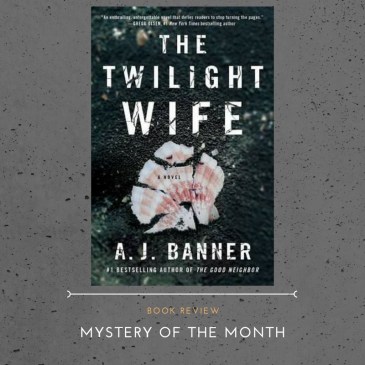
Mystery of the Month – The Twilight Wife

Instead of the usual ‘whodunnit’, the Mystery of the Month this month is domestic thriller The Twilight Wife by A.J. Banner.

A resident of the rural Pacific Northwest, A.J. Banner was inspired to write a novel set “on a remote, rainy, shadowy northwest island”. The fictional location of Mystic Island, in the San Juan Islands of Washington, provides the perfect backdrop for main character Kyra Winthrop as she struggles to remember – ‘who am I?’

A WOMAN WITH SECRETS

‘White blood cells live only a few weeks, red blood cells only about four months, but brain cells last a lifetime. When neurons die, they’re never replaced. I don’t recall where I learned all this, or how – but I know I’m only a shadow of my former self, as spectral as a dream.’ – Kyra Winthrop

Kyra Winthrop is recovering from a diving accident where she suffered a severe head trauma. As a result, she has forgotten everything that happened four years before the accident, the accident itself, and she struggles to form new memories.

A marine biologist, Kyra remembers certain things in great detail, including the scientific names for marine life. However, when it comes to her devoted and patient husband Jacob, she struggles to remember much about their marriage at all.

Feeling disoriented and alone, Kyra speaks to the residents of Mystic Island where Jacob brought her two weeks ago, to try and piece together the fragments of her life before the accident.

But who can she trust?

Jacob’s childhood friend Nancy seems friendly enough but it’s apparent she’s holding a torch for Jacob. There’s also something strange about Nancy’s husband Van, who describes Kyra as ‘a woman with secrets’.

And then Kyra encounters reclusive fisherman Doug Ingram, who appears to recognise her and urges her to leave her husband. Kyra discovers Doug’s paintings in the library, and they feature a woman who looks very similar to Kyra. Who could she be?

Even emails from her friend Linny, which used to bring comfort and reassurance, begin to signal to Kyra that something is amiss.

But most concerning of all are Kyra’s persistent dreams and flashes of another man – Jacob’s friend, the handsome Aiden Finlay.

MEMORIES OF ANOTHER MAN

 ‘He held me, and I could smell the damp wool of his sweater, the fresh soap on his skin. The fleeting image is so vivid it’s startling. I wanted him to hold on to me. A shot of adrenaline rushes through me, an interior tremor like the beginning of a tectonic shift.’ – Kyra Winthrop

 As Kyra’s memories start to return, they become more and more disturbing.

Jacob insists that he and Kyra had a happy marriage, but Kyra’s fleeting memories of passionate moments shared with Aiden, who is nowhere to be found, lead Kyra to believe she may have been planning to leave Jacob before the accident.

There are things Kyra can’t explain – a jagged scar on her right thumb, a dent in the bathroom door and whenever she tries to Google information about the accident, the internet connection is lost.

Then Kyra has an ominous dream about the accident where she sees another diver being yanked away by the sea – but Jacob insists that no one else was there. Her growing sense of dread only worsens when she recalls a strange conversation with Jacob, Nancy and Van about how to kill someone and make it look like an accident.

 It soon becomes apparent that someone is going to great lengths to prevent Kyra from finding out the truth.

A LITERAL CLIFFHANGER

 ‘His lips taste familiar. I’m enjoying his touch. I want him. I wanted him before. But something went wrong between us. And I suddenly remember thinking, “What secrets would I hide to save my marriage?”’ – Kyra Winthrop

We connect with Kyra and her fractured memories from the first chapter and become invested in her journey as she goes from readily accepting what she is told to questioning everything.

Banner cleverly drops subtle clues into the dialogue, hinting to the reader about what is really going on. It’s not long before we begin to doubt everyone in Kyra’s life.

The ‘off the grid’ island setting is conveyed without unnecessary over-description but evokes the imagery of the rocky coastline, dense fir forests, and beaches strewn with driftwood, giving a real sense of its remoteness and how it contributes to Kyra’s feelings of isolation.

Avid thriller readers may be able to make an educated guess about the ‘twist’ ending, but when Kyra does eventually realise the truth, the story rapidly picks up the pace and propels the reader towards a dramatic conclusion (which gets extra points from me because it literally occurs on a cliff).

The Twilight Wife by A.J. Banner is published by Touchstone.

Why you should do a writing course

‘One day, I am going to write a novel!’

These words have been spoken by many a budding author.

But how many people actually follow through on their declaration? As someone who has uttered the above mentioned words myself, I wondered where to begin. Armed with a slightly inflated view of my abilities, I thought ‘well, I’ll just write it.’ I mean, I was good at English at school. I can spell. And I can type fast. This will be easy, right?

Wrong.

I started off okay. I had my awesome premise and my cool main character and I thought I was ready to go. The opening scene was underway. But then – mind blank. What happens after that? I’d heard of an ‘inciting incident’ and a ‘midpoint reversal’ but what was I actually supposed to do when writing those parts of my story?

After I got home from work one day, I was thrilled to discover my wonderful husband had brought me home a copy of The Australian Writer’s Marketplace. (Consider this the ‘inciting incident’ of my writing career.) This is a lovely, thick guide to the writing industry in Australia and New Zealand, which includes contact details for anyone and everyone in print media and publishing, and information about courses and competitions.

For more information, you can buy the current copy here. Go on, it’s on sale.

I discovered that The Australian Writer’s Marketplace also has a shiny, magical online learning centre, with different courses on how to improve your writing, how to pitch to publishers, and the course that I signed up for – ‘Year of the Novel Online’.

I’m pleased to announce the writer who signed up for this course last February (spelling and typing skills aside), is a very different writer to the one who finished the course in December.

Each fortnight, I listened to the dulcet tones of Dr Kim Wilkins as she shared her words of wisdom via audio recordings on how to craft a story. These recordings were accompanied by exercises taking you from writing the beginning of the novel (planning, compelling characters, world building) to avoiding the saggy middle and dealing with things like writer’s block. There were some great exercises about transforming stereotypical characters, using the five senses to describe a room in a haunted house, and writing a first person account of what a detective would see at the murder scene of your main character.

Each course is also assigned a published writer as a tutor. I was lucky enough to have Natasha Lester as the tutor for my course. Students were given the opportunity to provide samples of their writing and receive feedback from Natasha. She really helped me stay on track, letting me know what I was doing well and when to be careful of things – such as becoming too clichéd, and being specific with details (i.e. don’t just say ‘noisy’ be specific about the noises).

There were so many other students who started the course with wonderful ideas for stories and I loved hearing everyone’s ideas. Unfortunately, as often happens, life gets in the way and many of those students dropped off the radar before the conclusion of the course. However, I did ‘meet’ some other awesome budding novelists. Remember the names Natalie Hennekam and Melissa Varoy in the future as I’m certain they will be published authors one day.

By the end of the course I had over 80,000 words of my 90,000 word novel – a significant chunk of my first draft. I also learnt that writing a novel is a real labour of love and that I’d been very naïve thinking that English skills alone would get me over the line. There are so many intricacies involved in crafting a story – but the best way to start writing is simply to actually start writing.

Now, instead of saying – ‘One day, I am going to write a novel!’ – I can say that I’m well on my way. My nebulous concept for a story has turned into a slightly unwieldy but worthwhile 80,000 words, and that’s real progress.

Of course, the journey doesn’t end there. The next step is ‘Year of the Edit!’