Why You Need An Editor To Read Your Manuscript

After an unsuccessful one-on-one with a publisher at a recent literary conference, I decided to engage a professional editor to read my manuscript (a cosy-crime). Although I’ve previously had helpful feedback from mentors about sections of my novel, what I really wanted was to get a professional opinion on the entire manuscript. I found a great editor easily through the Freelance Editor’s Network. I read through each editor’s bio, and chose an editor that worked with books in the same/similar genre to my manuscript.

Editors offer a range of different services including structural and developmental edits, copywriting and proofreading. I chose to receive an editorial assessment comprising of an approximately 10-page report on my entire manuscript. The report took into consideration the plot, genre, structure, narrative and characters, and finished with some miscellaneous thoughts about consistency and plot holes. The feedback in this report has made me see my manuscript in a new light and now that I know how much it can be improved and reworked, I’m glad I decided to engage an editor before submitting to any more agents, publishers or competitions.

The editorial assessment has done two things. Firstly, it has confirmed that certain things I suspected needed work, do in fact need work, such as:

  • Those opening chapters! Previous feedback regarding my opening chapters was that they felt too rushed. It starts right in the action, but the reader doesn’t get to know the main character, or their motivations well enough first, and it’s confusing. There needs to be more information for the reader to be able to orientate themselves in the world of the story before getting into too much of the action.
  • Characters. I used to think the weakest part of my writing was scene setting, and while this is still an area that could use some work, the main thing I struggle with is demonstrating to the reader the motivations of my main characters.

Secondly, the editorial assessment has drawn my attention to things I didn’t realise needed work, such as:

  • More exploration of the psychological elements of the murder mystery plot, including the motive of the murderer. This will also assist in making the story a bit darker, which is something I’ve discussed wanting to do in an earlier blog post.
  • A greater sense of time moving to create more tension. Despite mapping out all of the dates and times of each scene, this isn’t clear to the reader.
  • Subplots that aren’t pulling their weight. I’ve got lots of subplots and some of them haven’t been explored enough to engage and maintain the reader’s interest.

As an unpublished writer, after my experience engaging a professional editor to read my manuscript, I would absolutely recommend this to any new writers looking to improve their writing skills and learn more about the craft. Yes, it’s an expensive exercise but it’s absolutely worth the money if you can afford it. The feedback I received is another step towards my ultimate goal, which is to make my manuscript the best possible manuscript it can be. I knew it wasn’t there yet and needed more work. The editorial assessment has shown me there is still a lot of work to do before I will feel confident to submit it again to agents and publishers.

Have you ever sought professional advice on your writing? Please let me know in the comments below.
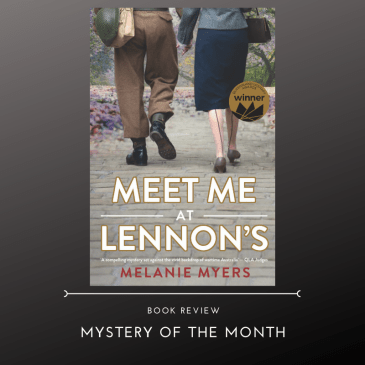
Mystery of the Month – Meet Me At Lennon’s

Melanie Myers transports the reader back to wartime Brisbane with her award-winning debut novel Meet Me At Lennon’s. In the early 1940s, thousands of American soldiers descended upon Brisbane and their presence was felt by all – they were glamorous, better paid and skilled at charming Australian women. Meet Me At Lennon’s explores the huge impact of this social disruption through the lives of several female characters. While there is a mystery surrounding a woman murdered on the banks of the Brisbane River in 1943, this isn’t a whodunit but a story about the experiences of these women and their connection to the ‘River Girl’.

Dual narratives cleverly connect and intersect, often unexpectedly, as the story moves between the 1940s, the 1990s and today. The contemporary narrative sees Olivia Wells struggling to complete her thesis on forgotten writer, Gloria Grantham, when she chances upon Clio Manning, a woman who may have the answers she needs. In the forties we meet Alice who receives lots of tips as a maid at the exclusive Brisbane hotel, Lennon’s. Her roommate, Val, who works at the munitions factory, loves to spend her evenings dancing and plans to elope with a US submariner. June’s husband is at war while she encounters a mysterious American stranger, while her sister Edith is expecting a proposal from ‘Frank the Yank’. Back in the present day, Olivia is managing the men in her own life – a lousy boyfriend and her absent father who suddenly wants to reconnect.

The reader must be astute and pay close attention to these timeline shifts because little details are hidden in the story, revealed in whispers. This is a book that needs to be read slowly, every line relished and absorbed. I enjoyed the way the author invented and incorporated theatre reviews, old letters and interview transcripts – we feel like we are Olivia, slowly piecing together a picture of life in 1940s wartime Brisbane. Like her main character, Melanie Myers spent time at Queensland State Archives trawling through articles about reports on sex offences committed by US soldiers to inform the context of the story, which is so well-researched and eloquently described that every scene feels like stepping through a window into the past.

Brisbane naturally features very heavily in the story – the present day vista of South Bank and its buildings – the State Library, Queensland Museum, and the Wheel of Brisbane; as well as familiar buildings that have stood the test of time – City Hall, McWhirters, and the Paddington Antique Centre, and those now long gone – Lennon’s Hotel on George Street, and the Carver Club, which once stood on Grey Street in South Brisbane, built for African American servicemen who were not permitted to cross the Brisbane River. A simmering animosity between the Australian and American soldiers culminates in the novel when one of the female characters witnesses a riot in the Brisbane CBD in November 1942, an actual event which came to be known as the Battle of Brisbane, resulting in one death and hundreds of injuries.

But it’s female experiences at the heart of this story, which holds a mirror up to the lives of women in wartime Brisbane and asks, how much has changed and how much remains the same? Sexual violence and victim blaming are hot topics and this is a novel that seeks to give these victims of sexual violence a voice, particularly those forgotten by history, and by novel’s end has given the River Girl a name. A thought-provoking read that will stay with you long after you’ve read the final page.

Meet Me At Lennon’s by Melanie Myers is published by UQP.

Standout Simile:

She pressed the pointed end of it into her palm, wishing it hurt more, and hoping it would quell the relentless nausea that was roiling up again like sediment in a rain-swollen river.

Crime Fiction Tropes in the #MeToo Era

Ah, the beginning of September. One of my favourite times of the year because it means two things. Number one – winter is over. And number two – the Brisbane Writers Festival. This year, I attended a session called “Crime Fiction and #metoo” featuring a panel of women – poet and writer Meera Atkinson, professor, doctor and writer Caroline de Costa and writer M.J. Tjia (who also writes as Mirandi Riwoe), moderated by writer and academic, Meg Vann. The topic for discussion was whether crime fiction perpetuates a culture of violence against women because of certain tropes the genre typically uses. Can we therefore still morally read and write crime fiction?

Meg Vann referred to one particular trope as ‘fridging’, which comes from the Women in Refrigerators website developed by comic book writer, Gail Simone. The concept originated from the Green Lantern comic when the character Alexandra DeWitt (girlfriend of the main character, Kyle Rayner) was murdered and her body stowed inside a refrigerator. The meaning of ‘fridging’ has now widened to encompass violence against women as a plot device to motivate the (usually male) protagonist into action. It is a cliched type of storytelling with negative connotations because it’s seen as devaluing the life of that female character i.e. they are more plot device than person. An article on Vox states that tropes like these distort reality and our view of women: “They don’t exist in a vacuum, but in a context where they both reflect and perpetuate the idea that women don’t have any agency over their own lives in the real world.”

Calling out this trope has been a step forward in changing the way stories represent women. The negative connotations of tropes like ‘fridging’ or the ‘dead girl’ trope combined with the #metoo climate has crime fiction writers thinking twice when writing about violence against women.

Sarah Bailey, author of three bestselling novels featuring Detective Gemma Woodstock, wrote an article on Women’s Agenda about the challenge of writing crime fiction in the immediate aftermath of the #metoo movement. She found herself questioning how she depicted Gemma’s experience of sexual harassment, and whether she had a special responsibility as a writer to “present a certain kind of story” – one with an empowered ending, even though this wouldn’t necessarily ring true for the character she had created. And at a recent Meet the Author session with Melanie Myers, author of Meet Me At Lennon’s, she stated she purposefully tried to do something different with the ‘dead girl’ trope by making a statement about violence against women in the 1940s by comparing it to the present day and asking – has anything changed and what are we doing about it?

The Staunch Prize was created by author and screenwriter Bridget Lawless to encourage writers to come up with stories that don’t rely on sexual violence, awarding the prize “to the author of a novel in the thriller genre in which no woman is beaten, stalked, sexually exploited, raped or murdered”. Sophie Hannah, poet and novelist, argues in an article in The Guardian that while its admirable that the prize wants to take a stand against violence against women, it’s not violence on the receiving end of that stand, but readers and writers. Instead she suggests a prize for the work “that most powerfully or sensitively tackles the problem of violence against women and girls.”

Certainly there are writers who have published books that utilise these tropes without being exploitative and gratuitous. In my opinion one of the best is An Isolated Incident by Emily Maguire. This novel focuses on the impact of a woman’s murder on her sister, and on community reactions to her death, as well as exploring the media’s obsession with ‘pretty dead girls’.

So, what did the panel of women at the Brisbane Writers Festival say when asked: “Can we still morally read and write crime fiction?” The answer: “Yes, but it’s tricky.” The takeaway message was that writers should create crime fiction that doesn’t use traditional tropes and that gives female characters a strong voice. Caroline de Costa stated that recent crime fiction features women as the solution and not as stereotypes. She believes that entertainment can bring messages of social justice. M.J. Tjia, whose Heloise Chancey mystery series features two strong female main characters, asked people to refocus on what they’re reading, and ask – who wrote it? Where did it come from? What is its truth?

As crime writers, or fans of reading the genre, should we feel like we are committing a moral crime for reading and writing about violence against women? I’m certainly no expert and I don’t have the answers. In fact, the more I research the subject, the more complex it becomes. My current work in progress uses the ‘dead girl’ trope. I only hope I can write it in such a way that it doesn’t perpetuate negative stereotypes. What are your thoughts on using these tropes in crime fiction? Please let me know in the comments below.

Meg Vann, Caroline de Costa, Meera Atkinson and M.J. Tjia discuss women in crime fiction.