The Roller-Coaster of Writing A Book
Last week I was feeling positive about my writing. But this week, I’ve been feeling quite negative.
I’m just over halfway through the first round of rewrites on my work in progress. After receiving feedback from a mentor, I’ve been strengthening character motivations, adding depth and texture and building on themes. Everything was progressing smoothly. But then I dipped into a sudden crisis of confidence. My mind was awash with irrational thoughts. You are wasting your life. The person who gave you feedback was just being nice. No one cares about your book.
This is the rollercoaster of writing a book (and could easily be applied to any creative pursuit). One second you’re cruising up the hill of productivity but then suddenly you’re charging down the steep decline of failure and going through the loop of self-doubt before coming to an abrupt halt at the procrastination station.
But rollercoasters are meant to be fun. They can be daunting, especially if you’re afraid of heights, but the thrill of flying through the air upside down and the excitement of your stomach dropping as you fall from a great height is worth that moment of trepidation before you get in and pull your lapbar down. So let’s try and flip this around.
The steep decline of failure
My goal was to finish rewrites by the end of January. Although there’s still over a week left before the end of the month, it’s not enough time to achieve my goal. I allowed procrastination to eat away precious minutes I could have been dedicating to my work in progress. I feel like I’ve failed.
But instead of screaming in terror, I remember the inspiration behind Bird by Bird by Anne Lamott – breaking down long projects into smaller parts. This makes goals more achievable and less intimidating. And instead of looking at my task as ten chapters left to review, I should be congratulating myself for already reviewing and rewriting 20 chapters!
As Roy Peter Clark says in Writing Tools: 55 Essential Strategies for Every Writer: “Tiny drops of writing became puddles that become rivulets that become streams that become deep ponds.” I’m somewhere between rivulets and streams and by setting realistic and achievable goals, I’ll hopefully soon have a body of water like Lake Baikal (which, with a maximum depth of 5,387 feet, is the deepest lake in the world).
The loop of self-doubt
Almost every writer/blogger has a post about self-doubt. Because we’ve all been there. There’s even a great story about imposter syndrome from Neil Gaiman that went viral after author Alan Baxter turned it into a meme.
Dorothea Brande wrote Becoming a Writer in 1934 and said that every writer goes through the despair of wondering whether they have anything worth saying. What will readers think when they read my work? Or perhaps they’ve read the work of a genius writer and believe the difference between the work of the genius and their own writing is so large, they will never amount to anything. It’s reassuring to hear all writers suffer from self-criticism, but these negative thoughts can be debilitating. So what do we do when they have us in a twist?
Roy Peter Clark recommends making a list of the negative things you’re telling yourself – then burn the list and flush the ashes. Or Anne Lamott suggests isolating each negative voice, one by one, and imagining the person as a mouse. Then pick up the mouse by the tail and drop it into a mason jar, securing the lid tightly shut.
I have two choices. Keep going or give up. And if I’m going to keep going, then I have to expect that every now and then my confidence will throw a zero-gravity roll my way. And when that happens, I’ll do the mason jar thing.
Procrastination station
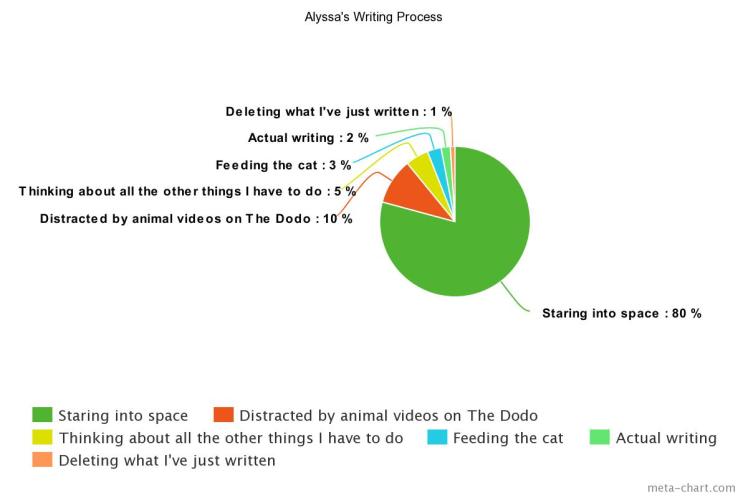
Then there’s all the time spent procrastinating – again, something most, if not all writers do. For example, my own writing process can be broken down by the following pie chart.
Roy Peter Clark asks the following question about procrastination: “What would happen if we viewed this period of delay not as something destructive, but as something constructive, even necessary? What if we found a new name for procrastination? What if we called it rehearsal?” For example, talking about writing with another writer is a great way to work through ideas. Or next time I’m staring into space, I can plan out ideas for my story my head.
Like a roller coaster, the process of writing a book has ups and downs. When you’re on the downward spiral of negative thinking, try these for positive g-forces – set achieveable goals, keep going, and eventually you will get the words down.
Buy Writing Tools by Roy Peter Clark.
Buy Becoming a Writer by Dorothea Brande.
Buy Bird by Bird by Anne Lamott.
 Alyssa Mackay | Writer