Don’t mess up your novel by overthinking it

I am really thinking about words at the moment. This week I spent over two hours on a 100 word paragraph in my second first draft. Deliberating over which words to choose – ‘expanding’ or ‘stretching’? Which is better? I wanted to get it right. But if I keep this up, my novel will never be finished. For a 90,000 word novel, that’s about 2.5 months without sleeping.

Last year, I took an art class where the subject was drawing a tree. The tutor explained how to draw the tree in detail – how the roots curve into the ground, how the branches expand (stretch?) out, how to give the impression of leaves rather than draw each individual leaf. Then to add detail – where the light falls, maybe add a tree hollow or background features like a bird or a cute rock. She drew an example on the flip board and handed out instructions.

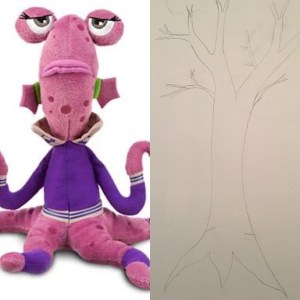
My first attempt at trying to copy the tree on the flip board was not good. It looked a bit like Carla Delgado – an octopus-like monster from Monsters University. My second attempt was only fractionally better and I still wasn’t feeling it. Frustrated, I thought: ‘I’ve just got to get this right!’
UHXQ5718
Similar


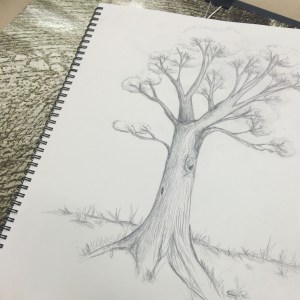
On my third attempt, I tried something different. I kept in mind the tutor’s instructions about how to draw the tree, but let the pencil flow without thinking too hard about what I was doing. This tree, Tree Number Three, turned out okay. I mean, they’re not about to hang it in the National Art Gallery but it looks like a tree and not a CGI octopus, which is a big deal.
170
Tree Number Three


Then I thought: ‘Is this a thing? Do I work better when I’m not thinking too hard about it?’ Turns out the answer is YES. And also, I’m a genius – because it is totally a thing. Based in SCIENCE.

The Scientific American wrote about a study where an associate professor at Stanford University Institute of Design and a behavioural scientist at Stanford’s School of Medicine designed an experiment based on Pictionary. Students were hooked up to a machine measuring brain activity and other technical science things, and given 30 seconds to draw a picture based on an action word. They indicated which word pictures they found more difficult to draw, while researchers decided which of their artistic efforts were the most creative. Turns out the participants’ left brains worked harder for the difficult word pictures and that they scored points for creativity when their right brain was more active.

Essentially, the less the participants thought about what they were drawing, the more creative their drawings were. Manish Saggar, a psychiatrist at Stanford and the study’s lead author, summarized the findings: “The more you think about it, the more you mess it up.”

I was messing up my tree because I was overthinking it. When I kept the tutor’s instructions about how to draw the tree in the back of my mind but didn’t overthink them, it actually became easier to draw. The same can apply to my writing. I know the process. The plot needs structure and turning points, and my settings need to be anchored, etc. – but when I write, I need to stop overthinking things and trust my right brain to pull the magic out of my subconscious.

This is summed up perfectly by K.M. Weiland on her blog, Helping Writers Become Authors:

Fiction is an amalgam of art and craft. We can think about craft. We should think about craft. Craft is an analytic, left-brain exercise. Art, on the hand, is a deeply subconscious, emotional journey. We shouldn’t think too hard about that—at least, not while we’re in the act. Thinking too hard dries up the creative side of the brain and dams up that subconscious flow of ideas, words, and images.

The left brain may still try to take over. Even when Tree Number Three was looking particularly tree-like, I used the eraser a few times when something wasn’t working, just like the way I might delete a sentence or paragraph.

And I was also compelled to keep adding to my illustration. What about a bit more shading here? Or another cute rock? The art tutor told me to stop – it was enough. So when you’re in your obsessive, creative right-brain state, you may add too many adjectives to describe the way your main character raises their eyebrows. It’s your first draft, and it’s not going to be perfect. But that’s okay.

As Robert Graham says in his book How to Write Fiction (And Think About It):

Each finished work will always in the end fall far short of the form you imagined it taking when you first conceived it. So it’s worth bearing in mind that there’s only so much you ought to do in the way of perfecting each piece of fiction you write; you might as well recognise that each new work you begin offers you a further opportunity to develop your craft, complete your masterpiece. There comes a point in the redrafting of everything you write when you will benefit from stopping and moving on to your next story or novel.

But redrafting is a blog post for another day, when we make friends with our left-brains again! Until then, I’ll keep my writing processes deeply rooted while I plant seeds of creativity and watch my novel grow as I think (but not overthink) about other terrible tree idioms.

Mystery of the Month – In Farleigh Field

In Farleigh Field: A Novel of World War II is a historical thriller from English author Rhys Bowen. Bowen is the writer of several bestselling mystery novels, including the award-winning Molly Murphy and Royal Spyness series. This is her first major stand-alone novel.

Set in World War II in the midst of the London blitz, the mystery our main characters must solve is exposing the spy hiding amongst them in their home at Elmsleigh in Kent.

Bowen, who was born towards the end of the war, had personal reasons for wanting to write about wartime and about the English people who would do whatever it took to win the battle of good versus evil.

STIFF UPPER LIP AT ALL TIMES

“We must set an example,” her father had said in his normal thundering manner, pounding on the table for better effect. “Never let anyone see you are upset or afraid. People look up to us, and we have an obligation to show them how it’s done.”

A soldier parachutes to his death in the fields of Farleigh Place, the distinguished Kent home of the Sutton family. He carries a mysterious photograph.

The Royal West Kent Regiment are occupying Farleigh Place alongside the Earl of Westerham, his wife, Lady Esme, and their daughters. The downed solider wears the Royal West Kents uniform but Colonel Pritchard declares he is not one of them.

Is he a German spy? And if the photograph is a message – who is the intended recipient?

Family friend of the Sutton’s, Ben Cresswell, is recruited to MI5 after an injury renders him unable to realise his dream of joining the RAF. He is tasked with finding out who the soldier was and who he was trying to communicate with.

Lady Pamela ‘Pamma’ Sutton, the Earl’s middle daughter, is working at Bletchley Park, decoding German messages. When she sees a newspaper article that her childhood sweetheart, flying ace Jeremy Prescott, has escaped the Stalag Luft and is back in England after being feared dead, she returns home to Farleigh, hoping to rekindle their romance.

But the suave and dashing Jeremy turns his nose up at the idea of marriage with Pamela – he just wants to get her into bed. As Pamela’s Bletchley cohort, Trixie, tells her – Jeremy is NSIT (‘Not Safe in Taxis’). This gives ‘steady as a rock’ and Pamela’s lifelong admirer, Ben, the opportunity to show her how much he cares for her as they work together to uncover the identity of the spy.

AN EXPLOSIVE REVEAL

She had not realised before that fear had a smell. She had always been told that dogs can smell fear but she’d never heard it said of humans. Yet she identified it now, sweet and palpable as she sat on the chair in a dark room. She was not sure whether the fear was coming from her own pores or was part of the building, oozing from the walls where so many people had felt terror and desperation.

Unbeknownst to her family, older sister Margot Sutton – who has been living in Paris and studying fashion under Coco Chanel inspired character, Gigi Armande – is in serious danger. She’s been taken by The Gestapo – they want to use her as bait to get information out of her lover, Gaston, a member of The Resistance, and they’ll use whatever force is necessary.

When Ben learns of a group called ‘The Ring’ (based on real life pro-Fascist movement ‘The Link’) – British aristocrats who want the war to end before Britain is destroyed, even if that means Germany wins – he begins to wonder if the spy is someone he knows.

While society’s elite enjoy a party in Jeremy’s Mayfair flat, another bomb attack takes place over London and the reckless guests gather on the roof to watch the show. At the same time, Pamela’s romantic aspirations are bombed by someone close to her.It all cumulates at Lord and Lady Sutton’s garden party where Ben and Pamela must prevent the assassination of the Prime Minister and the entire cast of characters assemble for a dramatic, gun-slinging showdown where the spy is finally revealed.

CARELESS TALK COSTS LIVES

Pamela sat staring out of the window, fighting back the nagging worry that threatened to engulf her. Someone should have broken the U-boat code for that day. Someone should have been able to warn the convoy and send out planes to protect it. Until now, her work at Bletchley had seemed like an academic puzzle unrelated to real events. But at this moment, the importance of what was being done in the huts there hit her with full force.

In Farleigh Field calls attention to the fact that many people were doing important work for their country during the war, unable to admit their true occupations to their families. The character of Pamela signs the Official Secrets Act and the Sutton family think she is undertaking tedious office work, like filing. And men like Ben may have been wrongly viewed as feeble because they weren’t on the front line, fighting with their fellow countrymen.

There’s lots of characters to love, particularly Alfie, the gamekeeper’s boy who develops a friendship with the youngest Sutton daughter, Phoebe. After their discovery of the fallen solider, the pair snoop around trying to find the spy and getting into strife. There’s also friction involving sister, Diana ‘Dido’ Sutton, who has been denied her season because of the war and parades around Farleigh looking like a fashionable land girl, batting her eyelashes at all the eligible men.

Plenty of suspenseful action scenes keep the reader engaged throughout and the subplot of the love triangle between Pamela, Ben and Jeremy plays out as expected but never ventures into cheesy territory. And although you may think you’re clever enough to correctly guess the identity of the spy, there’s a further twist you may not see coming.

Bowen deftly crafts the story with rich settings, impeccable historical accuracy and authentic characters in such a way that it feels like In Farleigh Field is a film playing inside your head. And with limited published autobiographies on the subject, Bowen allows those people who were sworn to secrecy for so long to finally have their stories told in compelling fiction.

In Farleigh Field by Rhys Bowen is published by Lake Union.