Stuck on the Middle

Think back to a time before you started writing. Those heady days when you blissfully read novel after novel, happily ignorant to the fact that somewhere in the story, there was a plot point known as a midpoint reversal.

You probably even read the midpoint thinking, ‘wow, what a twist!’ Or perhaps, ‘gosh, what is (insert main character’s name here) going to do now?’ Maybe you had a sense that a major shift had occurred in the narrative, propelling you into the second half of the story. But you didn’t question what it was. You just kept on reading, absorbing the story without analysing it.

That was how I used to be.

But now I’m hyperaware of PLOT (ugh, plot, amiright?) And within all those turning points that make up the plot, there is one particular turning point that you will usually find, oddly enough, in the middle of the narrative. You guessed it – it’s the midpoint reversal.

So now when I listen to a novel on Audible I think – I’m about halfway through. Surely something extra dramatic is about to happen soon. Or when I see my Kindle is at 50% but nothing earth-shattering has happened in a while, I wonder – where is the midpoint scene? Is it running late?

I recently attended a Plotting Masterclass run by author Natasha Lester where she discussed the emotional elements of plotting a novel. If you have the opportunity to attend one of Natasha’s masterclasses, I highly recommend it so that you can listen to her discuss in detail what she calls her ‘three story sparklers’ and the impact they have on plotting. But today, I’m focusing on that murky midpoint, which Natasha says is a big dramatic scene, often involving blood, death or break up.

Natasha has the following to say about the midpoint reversal:

  • It’s a key standout scene in your narrative
  • It’s caused by all the events that have led up to it and in turn causes all the events that follow it
  • It causes your character to stop reacting and to take action
  • It alters your character’s journey – they really start to fight for something, it teaches them a big lesson and causes them to change
  • When planning your midpoint reversal, you should ask yourself what is the event, what action does your protagonist take as a result and how does it change them?

In The Weekend Novelist Writes a Mystery, Robert J.Ray and Jack Remick say: ‘Midpoint is big. Spending time here now will make your writing easier later.’

In summary, the midpoint is super important, okay? Don’t stuff it up. No pressure.

Let’s take a look at some examples of midpoint scenes in books written by authors who totally knew what they were doing.

In The Girl on the Train by Paula Hawkins, Rachel sees a news report – they’ve found Megan’s body in the woods, less than five miles from her home. This is right near where Rachel was that night, only she can’t remember what happened because she was intoxicated. Staying true to the rule of a big, dramatic event involving blood, death or break up, this midpoint has a significant death. Rachel now decides to takes action. She feels guilty and responsible, and wonders if she could somehow have been involved in Megan’s death. She shows up at Megan’s house and forms a relationship with her husband. She actively spends the second half of the novel trying to remember what she did that night and trying to figure out what happened to Megan.

In Fetish by Tara Moss, the first novel in the Makedde Vanderwall series, Mak succumbs to the charms of Detective Andy Flynn while the killer sits outside her apartment, waiting for an opportunity to pounce. The next morning, Andy is awoken by a phone call telling him that soapie star Becky Ross has been found murdered by the ‘Stiletto Murderer’ – grossly disfigured and naked except for one stiletto shoe. This victim is in a much worse state than the others, indicating the killer kept her alive while torturing her. Andy realises with horror that the killer is evolving. Again, we have blood and death and the hunt for the serial killer intensifies with increased stakes for main character, Mak, as she tries to find out who murdered her best friend before she becomes the next victim.

In And Then There Were None by Agatha Christie, the midpoint reversal occurs after three murders have already taken place and the seven people remaining on the island realise that the killer is amongst them. They notice that each time one of them is murdered, one of the ten figures on the dining room table is removed. This affects the behaviour of all the characters as they grow paranoid, suspecting each other and fearing they might be next. They lock their bedroom doors at night and stay in groups as they move around the hotel.

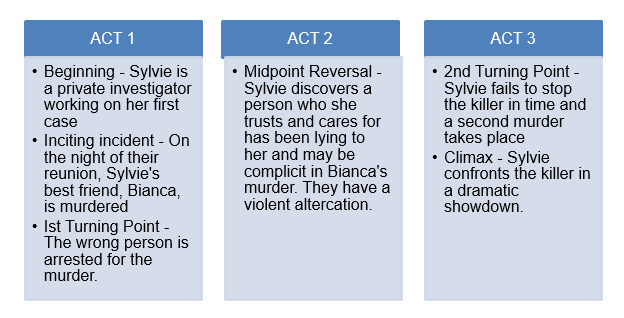
With all of this information in mind, I’ve crafted a midpoint reversal for my own story, The Princess Murders, which I’m hoping ticks all the boxes. In my story, Sylvie is investigating the murder of her childhood friend, Bianca. The diagram below shows the key plot points (summarised so they don’t give too much away – my husband is going to read it and I don’t want to give him too many clues.) The midpoint reversal occurs when Sylvie learns that someone she trusts has been lying to her and might be dangerous. Not only that, but a secret is revealed indicating that person may also be complicit in Bianca’s murder. In the scene where Sylvie confronts that person, a violent altercation ensues.
Screenshot 2017-03-20 18.50.27

Reflecting on Natasha’s words that the midpoint often involves blood, death or break up, I’m hoping I’ve got this covered because my midpoint has a little bit of blood and a definite break up – the relationship between Sylvie and the person who has been lying to her has been done irreparable damage.

As I continue to work on my manuscript, I’m also listening to Truly Madly Guilty by Liane Moriarty on Audible and I am not, under any circumstances, going to let myself become distracted waiting to analyse the midpoint scene. (But it’s going to be what happens at the barbecue – am I right?)


Mystery of the Month – The Girl Before

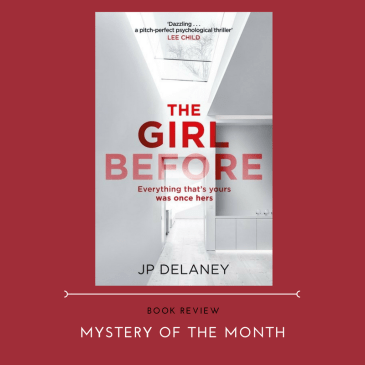
The Girl Before by J. P. Delaney is the latest in a line of thriller ‘Girl’ novels being hyped as the next The Girl on the Train or Gone Girl.

Delaney is the pseudonym of an author who has ‘previously written bestselling fiction under other names.’ If you do a Google search, it will tell you that J.P. Delaney is suspense and thriller writer Tony Strong, who has also written under other pseudonyms and whose works include The Poison Tree, The Death Pit, The Decoy and Tell Me Lies.

The Girl Before focuses on two women who take turns narrating the story – ‘Then: Emma’ and ‘Now: Jane.’

THE GIRL NOW

‘I know it must look odd, given that I didn’t even know Emma. But it seems to me that almost no one really knew her. Everyone I speak to has a different version of what she was like.’ – Jane Cavendish

Jane Cavendish is a single woman looking for an affordable rental home. She can no longer bear to live in the house where she was meant to bring home Isabel, the baby girl she lost following a tragic stillbirth.

A real estate agent suggests Jane look at One Folgate Street – a one bedroom house in Hendon, North London – designed and owned by famous architect and ‘wayward genius’ Edward Monkford.

Jane loves One Folgate Street’s minimalist-style, amazing architecture and state-of-the-art technological features. She’s keen to move in, but there’s a catch. Renting the house is subject to her implicit agreement to specific and stringent rules – no wastepaper baskets, no coasters, no cushions, or knickknacks. Jane must also complete a comprehensive application form asking intrusive questions about her past relationships, and a requirement for three recent photographs. Sounds legit, yeah?

Edward is pleased with Jane’s application and invites her to meet with him. Jane finds Edward dashingly handsome and naturally, her first thought is that she wants to sleep with him. Jane’s obsequiousness pleases Edward and he allows her to move into One Folgate Street.

It’s here that Jane learns about One Folgate Street’s previous resident, Emma Matthews.

THE GIRL BEFORE

‘I realise something. I haven’t had a single flashback or panic attack since I stepped inside the house. It’s so cut off from the outside world, so cocooned, I feel utterly safe. A line from my favourite movie floats into my head. The quietness and the proud look of it. Nothing very bad could happen to you there.’ – Emma Matthews

When we meet Emma, she is having vivid, violent flashbacks of being threatened with a knife during a burglary when she was home alone. Emma tells her devoted boyfriend, Simon, that she wants to move out and they are shown One Folgate Street.

When Emma and Simon meet Edward, Emma spills coffee all over Edward’s drawings. He doesn’t seem to mind and before they know it, their application has been accepted.

But as we learn more about Emma, we start to wonder if we can believe everything she says. When police find an incriminating video on her mobile phone, she claims that she was raped by the men who burgled her home. But something doesn’t add up.

Emma soon gives devastated Simon the flick and embarks on an intense and fairly icky sexual relationship with Edward. Edwards tells her (and later, Jane, when he seduces her, too) that he only has ‘unencumbered relationships’ because ‘you appreciate the other person more, knowing it’s not going to last.’

Not only does Emma’s relationship with Edward not last, but Emma never leaves One Folgate Street. Not alive, at least.

AN EXPERIMENT IN LIVING

 It is better to tell a lie and remain in control of the situation than to tell the truth with unpredictable results. Agree or disagree?

One Folgate Street is operated by ultrasonic motion sensors and a system called ‘Housekeeper.’ Housekeeper is very controlling – restricting what you can search for on the internet and turning off the lights and the shower if you don’t complete a regular ‘questionnaire’ that asks complex ethical and moral questions.

When Jane discovers Emma was murdered at One Folgate Street, she is not as concerned as she should be. When she learns that Edward’s wife and son also died while the house was being built and are buried on site, she still isn’t freaked out.

And even finding out that both she and Emma bear a striking resemblance to each other, and to Edward’s ex-wife, isn’t enough to deter her from her ‘unencumbered relationship’ with Edward.

As the story switches between both points of view, it becomes apparent that Edward’s relationship with Emma parallels his new relationship with Jane. He buys them identical pearl necklaces, controls their diet and exercise plans, and loses it when Jane doesn’t put away her toiletries.

WHO IS IN CONTROL?

 ‘You can make your surroundings as polished and empty as you like. But it doesn’t really matter if you’re still messed up inside. And that’s all anyone’s looking for really, isn’t it? Someone to take care of the mess inside our heads?’ – Jane Cavendish

 For quite a complex plot, The Girl Before is fast-paced and told very simply, which makes it a quick and easy read.

At times I wanted to give up, but I was driven on by my desire to know what happened to Emma. Who killed her? Was it Edward? Simon? Simon’s sleazy best mate? The overly invested policeman? Edward’s stalker? Or maybe the teenager who broke into Emma’s apartment?

Emma’s conversations with Simon, her therapist, the police, and everyone in her life are written without quotation marks, which is a clever tool that makes the reader unsure whether they can trust her version of events.

The heartbreaking description of Jane losing her baby girl makes us really feel for her and this continues in a subplot where she considers the possibility of negligence by the hospital. We want things to work out for Jane, but as she continues to stay at One Folgate Street even when there is a possibility that Edward might have murdered Emma, we begin to wonder what her real motives are. And maybe that’s the whole point – who, in this story, is actually sane?

As with the Girl books that came before, The Girl Before will also hit the big screen, currently being marketed as –  ‘soon to be a major motion picture by Ron Howard.’ But ultimately it loses points from me for (spoiler) killing a cat.

The Girl Before by J.P. Delaney is published by Hachette Australia.